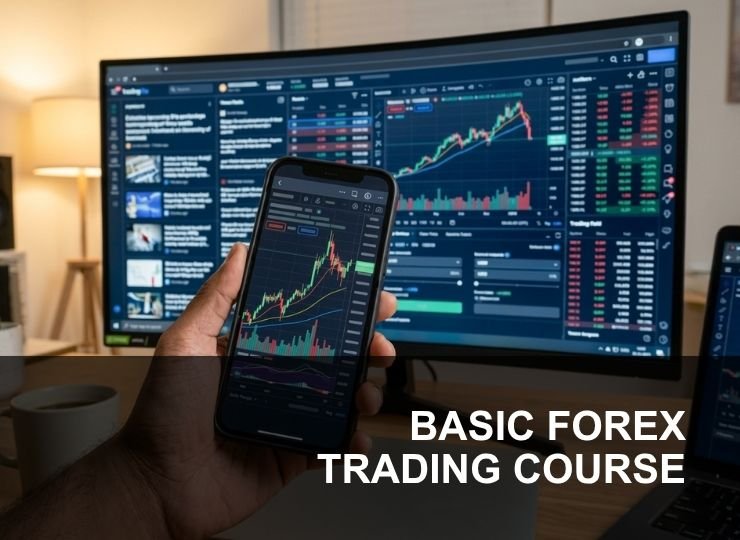
A basic Forex trading course introduces how currency markets work, explains key concepts like currency pairs, pips, and leverage, and teaches beginners how to analyze price movements and manage trading risk.
Ever opened a trading app, stared at a wall of currency pairs, and closed it five minutes later feeling more confused than when you started? You're not alone.
Every trader in Dubai's busy financial scene started exactly where you are now. The difference between the ones who eventually trade with confidence and the ones who give up usually comes down to one thing: they took a basic forex trading course before risking real money.
This guide walks you through everything you need to know to get started without the jargon overload.
What Is Forex Trading, Really?
Forex (foreign exchange) trading is simply buying one currency while selling another, hoping the exchange rate moves in your favour.
Think of it like this: when you exchange AED for USD before a trip to New York, you're technically doing a forex transaction. Traders do the same thing, just at scale, and to profit from the rate changes rather than to fund a holiday.
The forex market is the largest financial market in the world, with trillions of dollars traded daily. It runs 24 hours a day, five days a week, across major financial hubs, including right here in Dubai.
Why Forex Trading Matters for UAE-Based Traders
Dubai has become a genuine hub for retail and institutional trading, and there are a few practical reasons why.
The UAE's time zone sits conveniently between the Asian and European trading sessions, meaning you can catch major market moves without staying up all night. Many UAE residents also already manage multi-currency income or savings, so currency awareness isn't new; it just hasn't been formalised into a skill.
And because the UAE has a growing, well-regulated financial education sector, learning to trade properly rather than picking it up from random YouTube videos is more accessible than ever.
Forex Market Basics Every Beginner Should Know
Before opening a single trade, you need to understand how the market actually works. These forex market basics form the foundation for everything else.
How the Market Operates
Unlike the stock exchange, forex has no single physical location. It's a global network of banks, brokers, and traders connected electronically.
This is why it never sleeps during the trading week when Tokyo closes, London opens, and so on.
Key Market Participants
Central banks, commercial banks, hedge funds, corporations, and retail traders (that's you) all interact in this market. Each group trades for different reasons, some for profit, others for hedging or business operations.
Understanding who you're trading against helps explain why prices move the way they do.
Understanding Currency Pairs & Analysis
This is where most beginners get stuck, so let's keep it simple.
What Are Currency Pairs?
Every trade involves two currencies in a pair. EUR/USD, for example, shows how many US dollars one euro is worth.
The first currency is the base, and the second is the quote. If EUR/USD is trading at 1.0850, it means 1 euro = 1.0850 USD.
Major, Minor, and Exotic Pairs
Major pairs (like EUR/USD or GBP/USD) involve the most traded currencies and tend to have tighter spreads. Minor pairs exclude the US dollar. Exotic pairs include emerging market currencies and carry more volatility, generally not where beginners should start.
Technical vs Fundamental Analysis
There are two main approaches to currency pairs & analysis:
Technical analysis studies price charts, patterns, and indicators to predict future movement. Fundamental analysis looks at economic data, interest rates, and news events that drive currency value.
Most experienced traders use a blend of both, but as a beginner, it's worth learning them one at a time rather than juggling both from day one.
Risk Management & Trading Strategy: The Part Beginners Skip
Here's the uncomfortable truth: most new traders fail not because they pick the wrong direction, but because they manage risk badly.
Position Sizing
Never risk more on a single trade than you're comfortable losing entirely. A common rule among experienced traders is risking only 1–2% of your account on any one position.
Stop-Loss Orders
A stop-loss automatically closes your trade if the price moves against you past a certain point. It's not pessimism, it's protection.
Having an Actual Strategy
Strategy doesn't mean a secret formula. It means having clear rules for when you enter a trade, when you exit, and how much you're risking written down before you trade, not decided emotionally in the moment.
Solid risk management & trading strategy habits are what separate hobbyists from traders who last years in the market.