Analysis
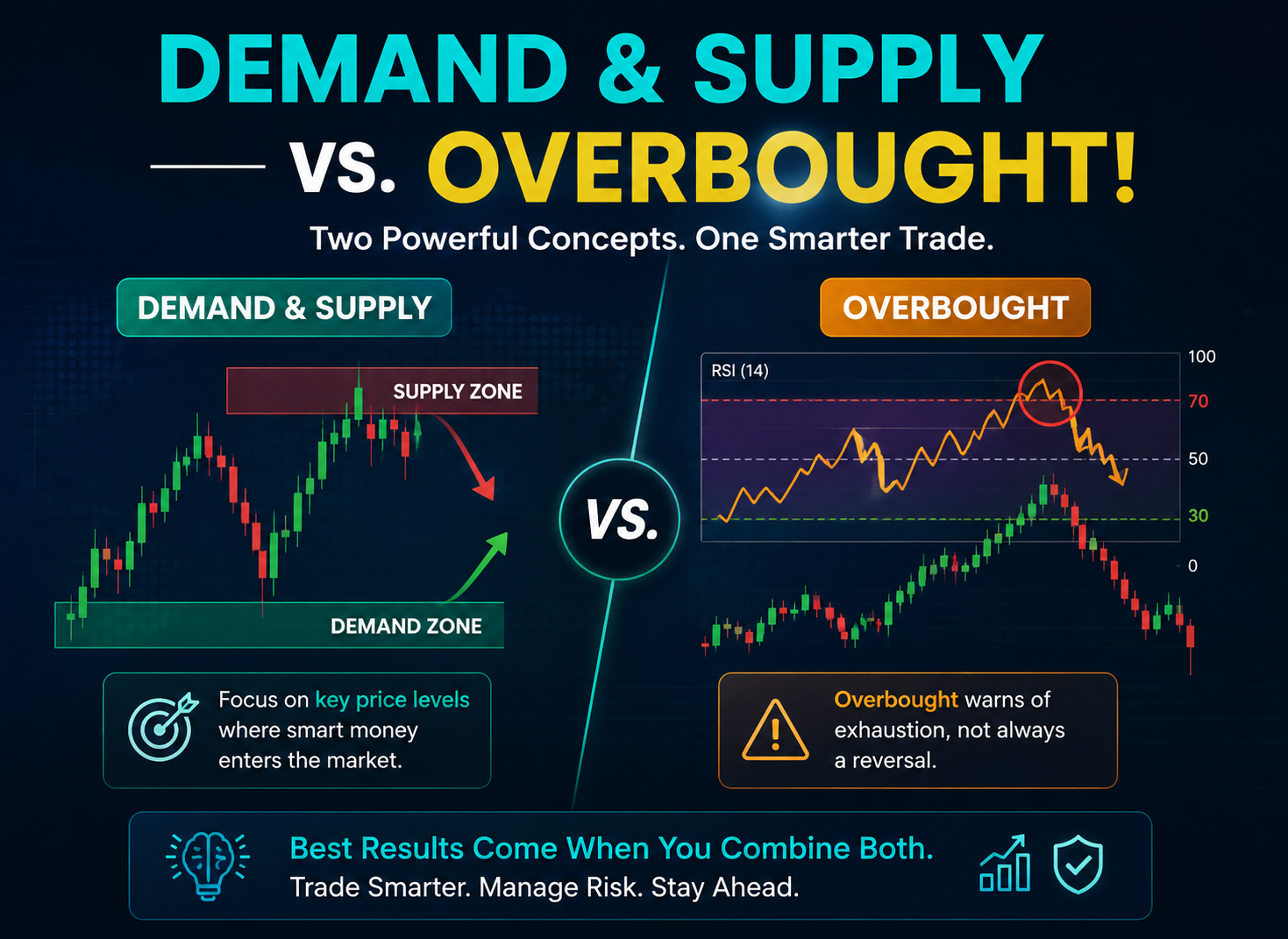
Demand & Supply shows the market’s balance, while Overbought highlights excessive buying pressure and the risk of a potential reversal.
Introduction
Morning Star, Doji, Hammer, Engulfing Pattern and many other candlestick patterns can help traders understand price action. But before focusing only on the shape of a candle, there is something more important to understand.
How fast is the market moving, and who appears to be in control: buyers or sellers?
This is where understanding demand and supply becomes important.
Don't Just Look at the Candle
Imagine a market has been falling around 100 points per day for several days.
Then suddenly, after the decline, the market rises 200 points in a single session.
Something has changed.
The size and speed of that upward move may indicate significantly stronger buying interest compared with previous sessions. Instead of immediately looking for another Sell simply because the overall trend was down, traders should recognize that buyers may now be challenging the sellers.
You may decide not to buy. That is completely fine. But blindly continuing to Sell without considering this change in momentum can increase risk.
Primexar provides Forex Portfolio Management Education to help traders understand portfolio diversification, risk allocation, capital management, and market analysis. Through structured forex trading education, learners can develop informed strategies to manage trading exposure and make more disciplined trading decisions.
Understand the Strength of Buyers
Consider another example.
The market has been continuously declining. Suddenly, buyers enter aggressively, and price makes a much larger upward move than the recent downward movements.
This is not simply a green candle.
It may be evidence that demand has increased.
The important question becomes: Why was the market able to move upward so strongly when sellers had previously been controlling it?
That change in behaviour deserves attention before taking the next trade.
What About a Sudden Large Fall?
Now imagine the market has already been declining around 100 points per day.
Suddenly, it falls another 200 or 300 points in a very short period.
But entering after an unusually extended move can be dangerous. The market may already be stretched, profit-taking may begin, or buyers may start entering at lower prices.
A large downward move does not automatically mean Sell. It means you should first understand what has happened to supply, demand, volatility and price momentum.
Speed of Movement Matters
Two markets can show exactly the same candlestick pattern but tell completely different stories.
A Hammer appearing after a slow decline is different from a Hammer appearing after an aggressive sell-off followed by strong buying.
Similarly, a bearish candle after a weak upward movement is different from a bearish candle appearing after buyers have aggressively pushed the market higher.
The candle tells you what happened during that period.
The speed and size of the movement around it give you context.
Don't Chase an Extended Market
One of the biggest mistakes traders make is entering after the strongest part of the movement has already happened.
When price suddenly accelerates downward, don't assume you must Sell.
When price suddenly accelerates upward, don't assume you must Buy.
First ask whether you are entering with emerging demand or supply, or simply chasing a move after it has already become extended.
Primexar offers Forex Trading Classes in Dubai to help beginners and experienced traders develop their knowledge of forex markets, technical analysis, and trading strategies. With structured learning focused on risk management and market analysis, learners can build a stronger foundation for informed trading decisions.
Read the Story Behind the Price
Instead of memorizing hundreds of patterns, start observing simple questions.
How strongly was the market moving before?
Has the speed suddenly changed?
Are buyers responding more aggressively than before?
Are sellers becoming stronger or weaker?
Is the current movement unusually large compared with recent sessions?
These observations can provide valuable context for any candlestick pattern or trading strategy.
Conclusion
Demand and supply are not simply about drawing zones on a chart. They are also about understanding the behaviour and strength behind price movement.
When buyers suddenly become significantly stronger during a downtrend, pay attention. When sellers aggressively accelerate an already extended decline, avoid blindly chasing the movement.
Don't trade only because you recognize a candle. Understand the battle between buyers and sellers behind that candle.
At Primexar, we encourage traders to move beyond memorizing patterns and develop the ability to understand price behaviour, market momentum, demand and supply before making trading decisions.
Morning Star, Doji, Hammer, Engulfing Pattern and many other candlestick patterns can help traders understand price action. But before focusing only on the shape of a candle, there is something more important to understand.
How fast is the market moving, and who appears to be in control: buyers or sellers?
This is where understanding demand and supply becomes important.
Don't Just Look at the Candle
Imagine a market has been falling around 100 points per day for several days.
Then suddenly, after the decline, the market rises 200 points in a single session.
Something has changed.
The size and speed of that upward move may indicate significantly stronger buying interest compared with previous sessions. Instead of immediately looking for another Sell simply because the overall trend was down, traders should recognize that buyers may now be challenging the sellers.
You may decide not to buy. That is completely fine. But blindly continuing to Sell without considering this change in momentum can increase risk.
Primexar provides Forex Portfolio Management Education to help traders understand portfolio diversification, risk allocation, capital management, and market analysis. Through structured forex trading education, learners can develop informed strategies to manage trading exposure and make more disciplined trading decisions.
Understand the Strength of Buyers
Consider another example.
The market has been continuously declining. Suddenly, buyers enter aggressively, and price makes a much larger upward move than the recent downward movements.
This is not simply a green candle.
It may be evidence that demand has increased.
The important question becomes: Why was the market able to move upward so strongly when sellers had previously been controlling it?
That change in behaviour deserves attention before taking the next trade.
What About a Sudden Large Fall?
Now imagine the market has already been declining around 100 points per day.
Suddenly, it falls another 200 or 300 points in a very short period.
But entering after an unusually extended move can be dangerous. The market may already be stretched, profit-taking may begin, or buyers may start entering at lower prices.
A large downward move does not automatically mean Sell. It means you should first understand what has happened to supply, demand, volatility and price momentum.
Speed of Movement Matters
Two markets can show exactly the same candlestick pattern but tell completely different stories.
A Hammer appearing after a slow decline is different from a Hammer appearing after an aggressive sell-off followed by strong buying.
Similarly, a bearish candle after a weak upward movement is different from a bearish candle appearing after buyers have aggressively pushed the market higher.
The candle tells you what happened during that period.
The speed and size of the movement around it give you context.
Don't Chase an Extended Market
One of the biggest mistakes traders make is entering after the strongest part of the movement has already happened.
When price suddenly accelerates downward, don't assume you must Sell.
When price suddenly accelerates upward, don't assume you must Buy.
First ask whether you are entering with emerging demand or supply, or simply chasing a move after it has already become extended.
Primexar offers Forex Trading Classes in Dubai to help beginners and experienced traders develop their knowledge of forex markets, technical analysis, and trading strategies. With structured learning focused on risk management and market analysis, learners can build a stronger foundation for informed trading decisions.
Read the Story Behind the Price
Instead of memorizing hundreds of patterns, start observing simple questions.
How strongly was the market moving before?
Has the speed suddenly changed?
Are buyers responding more aggressively than before?
Are sellers becoming stronger or weaker?
Is the current movement unusually large compared with recent sessions?
These observations can provide valuable context for any candlestick pattern or trading strategy.
Conclusion
Demand and supply are not simply about drawing zones on a chart. They are also about understanding the behaviour and strength behind price movement.
When buyers suddenly become significantly stronger during a downtrend, pay attention. When sellers aggressively accelerate an already extended decline, avoid blindly chasing the movement.
Don't trade only because you recognize a candle. Understand the battle between buyers and sellers behind that candle.
At Primexar, we encourage traders to move beyond memorizing patterns and develop the ability to understand price behaviour, market momentum, demand and supply before making trading decisions.