Trading Strategies
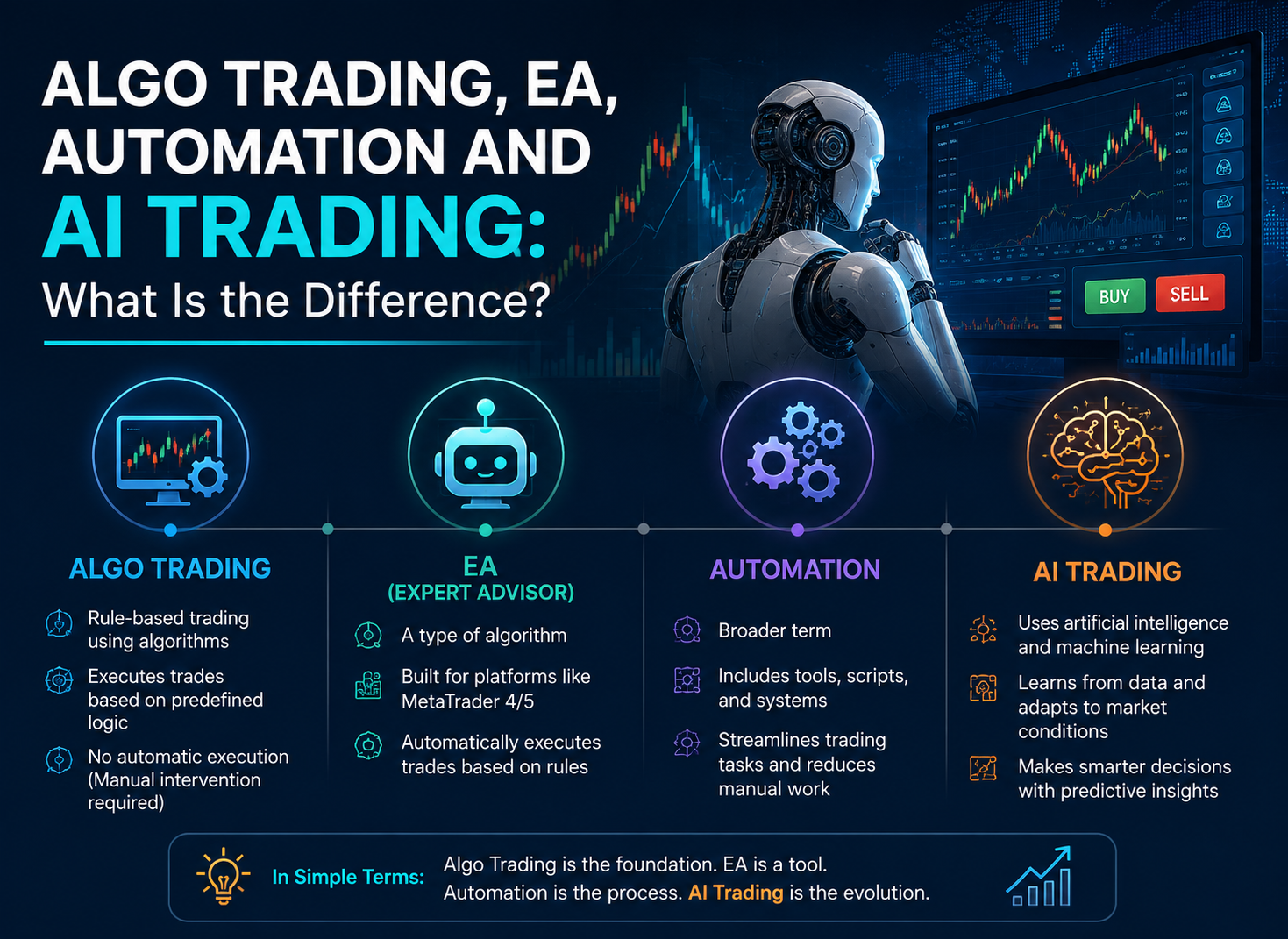
Algo trading, EAs, automation, and AI trading are related but distinct approaches, differing mainly in how strategies are designed, executed, automated, and enhanced through artificial intelligence.
Introduction
Technology is changing the way traders participate in financial markets. Today, terms such as Algo Trading, EA, Semi-Automation, Full Automation, AI Assistance, and AI Trading are commonly used. Although they may sound similar, they are not the same.
Understanding the difference can help traders choose the right technology based on their trading style and experience.
Primexar helps aspiring traders understand automated forex trading, Expert Advisors (EAs), algorithmic strategies, and automated market analysis through structured educational resources. Explore an Automated Forex Trading Course in Dubai with Primexar to learn how trading automation works, test strategies, and understand the importance of risk management.
What Is Algo Trading?
Algorithmic Trading, commonly called Algo Trading, uses predefined rules to identify and execute trading opportunities. For example, a trader can create a rule that says: If the price moves above a particular level and certain technical conditions are satisfied, place a Buy order. The algorithm follows the programmed conditions. It does not independently change the strategy unless it has been designed to do so.
What Is an Expert Advisor or EA?
An Expert Advisor is a program commonly used on trading platforms such as MetaTrader to automate specific trading instructions. For example, an EA can be programmed to enter a Gold trade when certain candle conditions are met, automatically place the Stop Loss and Take Profit, and manage the trade according to predefined rules. An EA is essentially a tool that converts a trading strategy or set of instructions into automated execution.
Join now for the Primexar AI Trading Webinar
What Is Semi-Automation?
Semi-Automation combines human decision-making with automated trade management. For example, a trader may analyze the market and manually decide when to Buy Gold. Once the trade is opened, automation can manage the stop-loss, take-profit, Break-Even, trailing stop, or partial closing. The trader makes the key decision, while technology handles repetitive tasks.
What Is Full Automation?
In Full Automation, the system handles the trading process based on predefined instructions without requiring the trader to manually enter every trade. For example, the system can identify a predefined setup, open the trade, calculate the position size, place the Stop Loss and Take Profit, manage the position, and close it according to the programmed strategy. The important point is that Full Automation still follows the rules created by the trader or developer.
What Is AI Assistance?
AI Assistance means using Artificial Intelligence to support the trader rather than allowing AI to make every trading decision. For example, a trader can use AI to analyze technical conditions, summarize economic news, compare different market scenarios, review a trading journal, or help develop and test a trading strategy. The AI provides information and analysis, while the final trading decision remains with the trader.
If you interested to learn about AI Trading, Join Primexar Webinar its Free for first 200 users
What Is AI Trading?
AI Trading goes beyond simply following fixed instructions. AI-based systems can be designed to process multiple types of information, recognize patterns, evaluate changing market conditions, and generate decisions based on their models. For example, an AI trading system could analyze price action, volatility, economic information, market sentiment, and historical patterns before generating a trading decision. However, AI does not eliminate market risk, and AI-generated decisions are not guaranteed to be profitable.
Primexar helps traders explore AI-assisted forex trading through educational resources covering artificial intelligence, automated trading systems, Expert Advisors (EAs), and data-driven market analysis. Learn how AI tools can support forex trading strategies and market research while understanding the importance of risk management and informed decision-making.
The Simple Difference
Algo Trading and EAs primarily execute predefined logic. Semi-Automation keeps the trader involved while automating selected tasks. Full Automation can manage an entire predefined trading process. AI Assistance helps traders analyze and make decisions, while AI Trading aims to use AI models as part of the decision-making process itself.
Conclusion
The evolution from manual trading to automation and AI is not about removing the trader completely. It is about using technology more effectively. At Primexar, our focus is to help traders understand these technologies step by step, from traditional trading and automation concepts to AI-assisted approaches, so they can understand both the opportunities and the risks before applying them in financial markets.
Technology is changing the way traders participate in financial markets. Today, terms such as Algo Trading, EA, Semi-Automation, Full Automation, AI Assistance, and AI Trading are commonly used. Although they may sound similar, they are not the same.
Understanding the difference can help traders choose the right technology based on their trading style and experience.
Primexar helps aspiring traders understand automated forex trading, Expert Advisors (EAs), algorithmic strategies, and automated market analysis through structured educational resources. Explore an Automated Forex Trading Course in Dubai with Primexar to learn how trading automation works, test strategies, and understand the importance of risk management.
What Is Algo Trading?
Algorithmic Trading, commonly called Algo Trading, uses predefined rules to identify and execute trading opportunities. For example, a trader can create a rule that says: If the price moves above a particular level and certain technical conditions are satisfied, place a Buy order. The algorithm follows the programmed conditions. It does not independently change the strategy unless it has been designed to do so.
What Is an Expert Advisor or EA?
An Expert Advisor is a program commonly used on trading platforms such as MetaTrader to automate specific trading instructions. For example, an EA can be programmed to enter a Gold trade when certain candle conditions are met, automatically place the Stop Loss and Take Profit, and manage the trade according to predefined rules. An EA is essentially a tool that converts a trading strategy or set of instructions into automated execution.
Join now for the Primexar AI Trading Webinar
What Is Semi-Automation?
Semi-Automation combines human decision-making with automated trade management. For example, a trader may analyze the market and manually decide when to Buy Gold. Once the trade is opened, automation can manage the stop-loss, take-profit, Break-Even, trailing stop, or partial closing. The trader makes the key decision, while technology handles repetitive tasks.
What Is Full Automation?
In Full Automation, the system handles the trading process based on predefined instructions without requiring the trader to manually enter every trade. For example, the system can identify a predefined setup, open the trade, calculate the position size, place the Stop Loss and Take Profit, manage the position, and close it according to the programmed strategy. The important point is that Full Automation still follows the rules created by the trader or developer.
What Is AI Assistance?
AI Assistance means using Artificial Intelligence to support the trader rather than allowing AI to make every trading decision. For example, a trader can use AI to analyze technical conditions, summarize economic news, compare different market scenarios, review a trading journal, or help develop and test a trading strategy. The AI provides information and analysis, while the final trading decision remains with the trader.
If you interested to learn about AI Trading, Join Primexar Webinar its Free for first 200 users
What Is AI Trading?
AI Trading goes beyond simply following fixed instructions. AI-based systems can be designed to process multiple types of information, recognize patterns, evaluate changing market conditions, and generate decisions based on their models. For example, an AI trading system could analyze price action, volatility, economic information, market sentiment, and historical patterns before generating a trading decision. However, AI does not eliminate market risk, and AI-generated decisions are not guaranteed to be profitable.
Primexar helps traders explore AI-assisted forex trading through educational resources covering artificial intelligence, automated trading systems, Expert Advisors (EAs), and data-driven market analysis. Learn how AI tools can support forex trading strategies and market research while understanding the importance of risk management and informed decision-making.
The Simple Difference
Algo Trading and EAs primarily execute predefined logic. Semi-Automation keeps the trader involved while automating selected tasks. Full Automation can manage an entire predefined trading process. AI Assistance helps traders analyze and make decisions, while AI Trading aims to use AI models as part of the decision-making process itself.
Conclusion
The evolution from manual trading to automation and AI is not about removing the trader completely. It is about using technology more effectively. At Primexar, our focus is to help traders understand these technologies step by step, from traditional trading and automation concepts to AI-assisted approaches, so they can understand both the opportunities and the risks before applying them in financial markets.