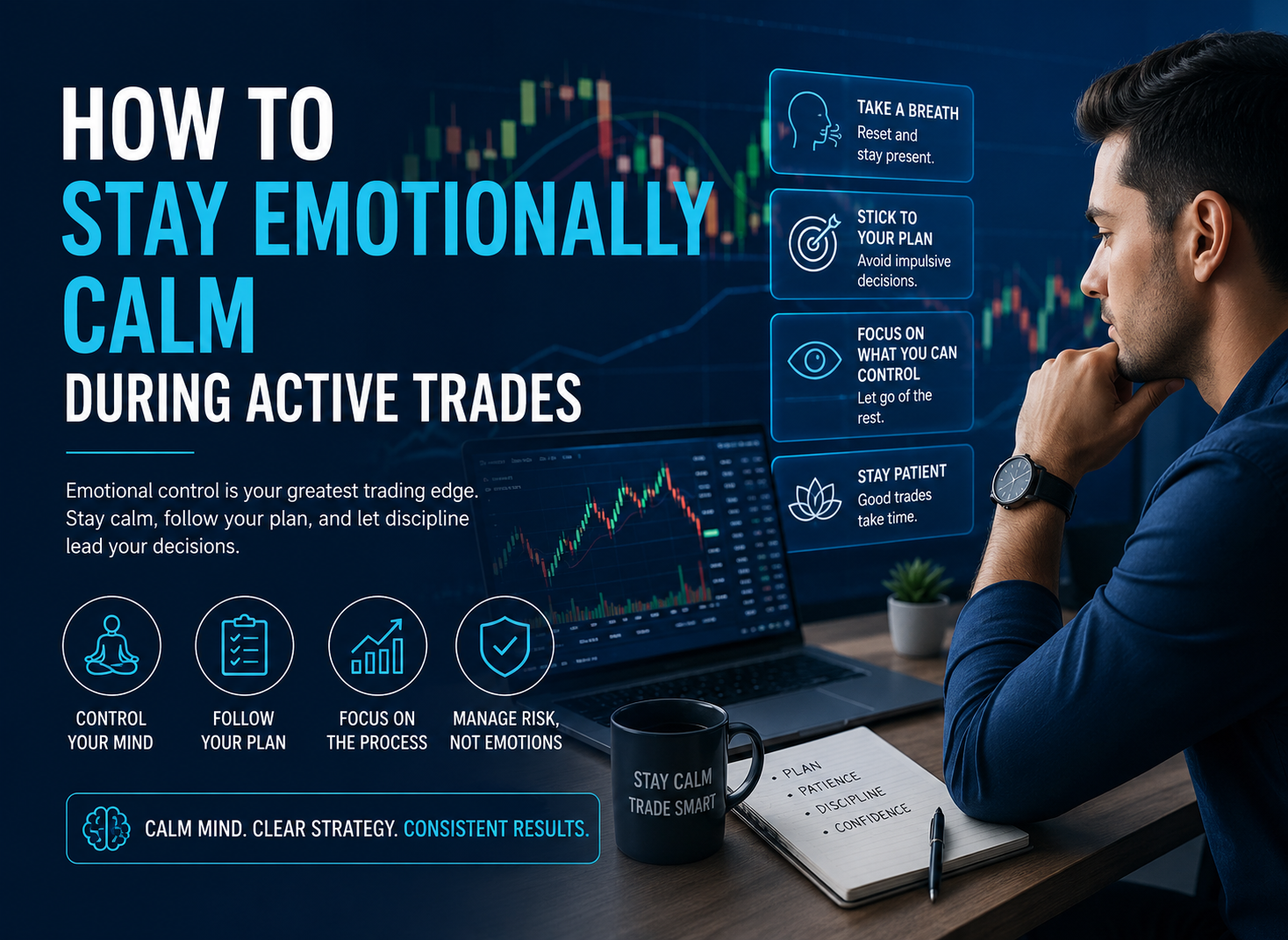
Emotions can quickly influence trading decisions. Stay calm by following your trading plan, managing risk, and avoiding impulsive reactions to short-term market movements. Focus on discipline and consistency rather than individual trade outcomes.
Why Emotional Control Matters in Trading
Markets can move rapidly, especially during major economic announcements, geopolitical developments, or periods of high volatility. When prices move against a position, fear can encourage traders to close trades prematurely. When a position moves strongly in their favour, greed can encourage excessive risk-taking.
Emotional
trading often leads to:
· Overtrading after a loss
· Increasing position sizes unnecessarily
· Moving stop-loss levels
· Taking profits too early
· Ignoring a predefined trading strategy
· Entering trades based on market noise
Successful traders understand that every trade does not need to be profitable. The objective is to follow a well-defined process and manage risk consistently.
Create a Trading Plan Before You Enter
One of the most effective ways to reduce emotional pressure is to make important decisions before opening a trade.
A trading plan
should clearly define:
· Entry conditions
· Stop-loss level
· Take-profit target
· Position size
· Maximum acceptable risk
· Market conditions that would invalidate the trade
Once these parameters are established, avoid making impulsive changes simply because the market moves unexpectedly.
Having a plan provides structure and helps prevent emotions from taking control during fast-moving market conditions.
Manage Risk to Reduce Stress
Risk management plays a major role in emotional stability. If a trade is too large relative to your trading account, even a small price movement can create significant psychological pressure.
Consider using a consistent risk level for each trade and avoid risking more simply because you feel confident about a particular market opportunity.
A properly sized position allows traders to accept normal market fluctuations without constantly watching every price movement.
Remember: A good trade is not necessarily one that makes money. A good trade is one that follows your strategy and manages risk responsibly.
Avoid Watching Every Price Movement
Constantly monitoring an open position can increase anxiety and encourage unnecessary decisions. Traders may react to every small price movement instead of focusing on the broader market setup.
After entering a trade, consider using predefined stop-loss and take-profit levels where appropriate. This can reduce the temptation to interfere with a position based on short-term market noise.
Stepping away from the screen can sometimes be one of the simplest ways to maintain discipline.
Learn to Accept Losses
Losses are an unavoidable part of trading. Even a strong strategy will experience losing trades.
Instead of viewing a loss as a personal failure, treat it as part of the probability-based nature of financial markets. Review whether the trade followed your strategy and risk-management rules.
If the process was correct, a losing trade does not necessarily mean the strategy has failed.
The goal is not to avoid every loss; it is to prevent one loss from turning into a series of emotional decisions.
Use a Trading Journal
A trading
journal can help identify emotional patterns over time. Record details such as:
· Why you entered the trade
· Your planned entry and exit
· Risk level
· Market conditions
· Emotional state before and during the trade
· Final outcome
· Lessons learned
Over time, your
journal may reveal patterns such as revenge trading, hesitation,
overconfidence, or entering trades after missing an earlier opportunity.
Recognizing these patterns is the first step toward improving emotional discipline.
Develop a Pre-Trade and
Post-Trade Routine
A
consistent routine can help create a professional mindset.
Before entering
a trade, ask:
1. Does this setup meet my strategy?
2. How much am I risking?
3. Where is my stop-loss?
4. Where is my target?
5. Am I entering because of analysis or emotion?
After closing the trade,
evaluate the execution rather than focusing only on profit or loss.
This
approach shifts attention from short-term results to long-term trading
discipline.
Stay Calm When Markets
Become Volatile
Market
volatility can create both opportunities and risks. Major economic data,
central-bank decisions, employment reports, inflation figures, and geopolitical
developments can cause rapid price movements.
During
volatile periods, avoid making decisions simply because the market is moving
quickly. Reassess your strategy, check your risk exposure, and determine
whether the current conditions still match your trading plan.
The calmer your
decision-making process, the less likely you are to let short-term market
movements control your actions.
Final Thoughts
Emotional
control is not about eliminating fear or excitement. It is about learning how
to make decisions without allowing emotions to override your trading plan.
By
combining disciplined risk management, a clear strategy, realistic
expectations, and regular self-review, traders can develop greater emotional
resilience.
In
active markets, staying calm can be just as important as identifying a good
trading opportunity.
Trade the plan, manage the
risk, and let discipline guide your decisions.
How Primexar Academy Helps
You Get It Right
Primexar
Academy was built specifically to address these gaps, not as a generic course,
but as a structured forex trading institute designed to deliver real outcomes.
Primexar is KHDA-approved, so you’re not gambling on the credibility of a
course; its educational standards have already been vetted and recognized.