Basic Trading
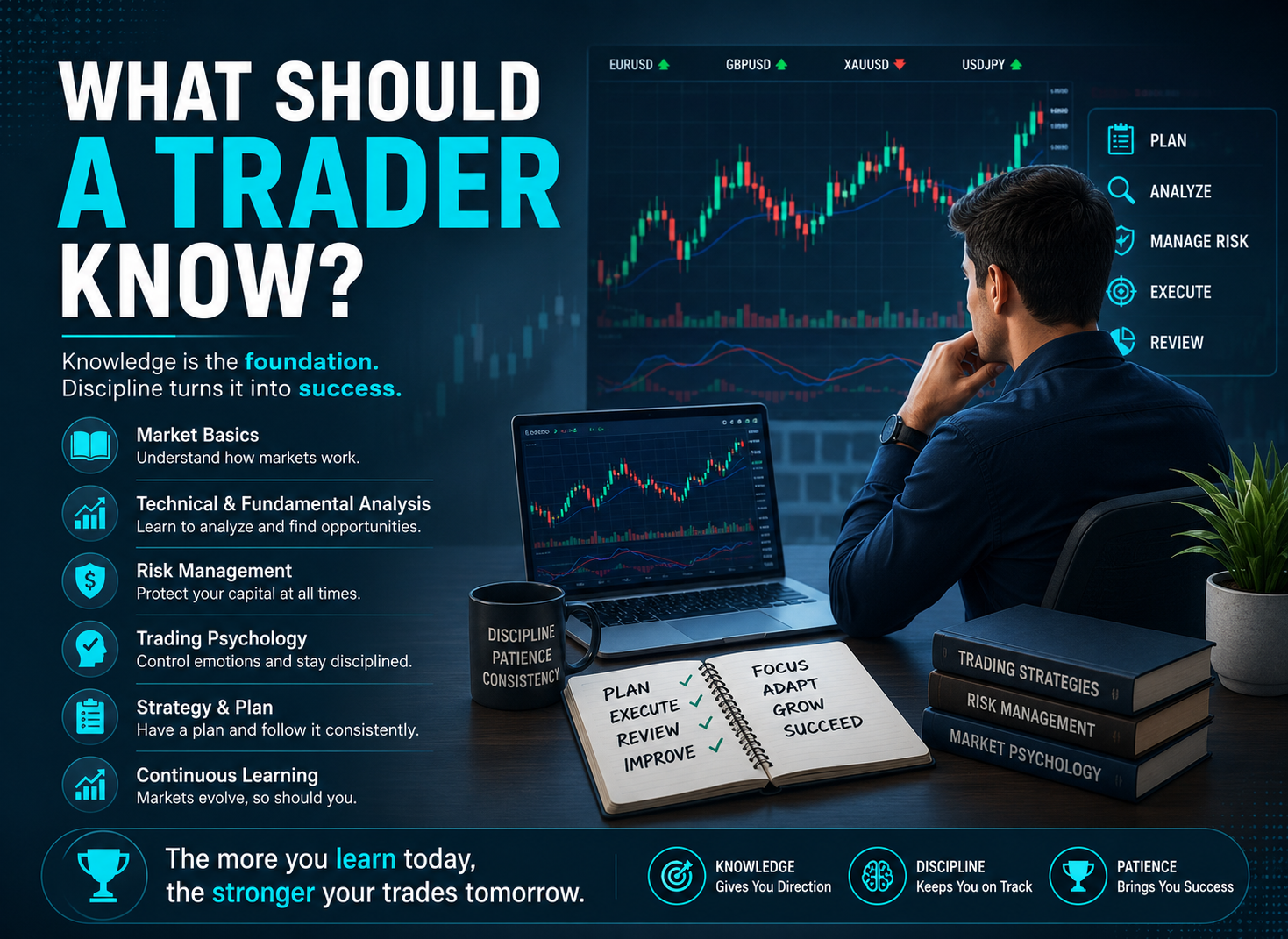
A successful trader should understand market trends, manage risk effectively, maintain discipline, and control emotions to make smart and consistent trading decisions.
Trading
is not simply about knowing when to Buy and when to Sell.
A trader may understand a good strategy but still struggle because of poor risk management. Another trader may understand technical analysis but ignore economic news. Successful trading requires knowledge across several areas.
Here are some of the most important areas every trader should develop.
Market Basics
Before trading, understand how financial markets work.
Learn about currency pairs, Gold, indices, commodities, stocks, bid and ask prices, spreads, pips, points, lots, leverage, margin, swaps and trading sessions.
Without understanding these basics, it is difficult to calculate the real risk behind a trade.
Technical Analysis
A trader should know how to read a chart rather than simply follow Buy and Sell signals.
Understand trends, support and resistance, demand and supply, candlestick behaviour, chart patterns, breakouts, volatility and commonly used technical indicators.
More importantly, learn why price is behaving in a particular way.
Fundamental Analysis
Markets do not move only because of technical patterns.
Interest rates, inflation, employment reports, GDP, central bank decisions and geopolitical developments can significantly influence financial markets.
A trader should understand the major economic factors affecting the instruments they trade.
Risk Management
This is one of the most important areas of trading knowledge.
Understand position sizing, stop-loss, risk-to-reward, account drawdown, leverage, margin and maximum acceptable loss.
A good trading opportunity with excessive volume can still become a dangerous trade.
Trading Strategy
Every trader needs a clearly defined trading setup.
Know what conditions are required for entry, when to exit, where the strategy should not be traded and how it performs under different market conditions.
A strategy should be something you can explain and test, not simply a feeling that the market will move up or down.
Trading Psychology
Fear and greed can influence even a technically strong trader.
Learn how to manage emotions after profits and losses. Understand overtrading, revenge trading, FOMO and the temptation to increase volume after a winning streak.
Discipline is often the difference between knowing a strategy and actually following it.
Money and Capital Management
Risk management looks at individual trades, while capital management looks at the bigger picture.
A trader should understand how much capital to allocate to a strategy, how profits should be managed, when exposure should be reduced and why protecting trading capital is important for long-term survival.
Backtesting and Trading Journal
Don't judge a strategy from five or ten successful trades.
Test it across different periods and market conditions. Record your entries, exits, profits, losses and reasons for taking each trade.
A trading journal allows you to identify what is actually working instead of relying on memory.
Economic Calendar and Market Timing
A trader should know when important economic announcements are scheduled.
Central bank decisions, inflation data, employment reports and other major events can create sudden volatility.
Knowing what is happening and when it is happening is an essential part of preparing for the trading day.
Automation and Expert Advisors
Modern traders should also understand the basics of trading automation.
Learn how predefined trading rules can be converted into Expert Advisors, alerts, automated risk management and trade-management systems.
You don't necessarily need to become a programmer, but understanding what can and cannot be automated can be extremely valuable.
AI Assistance
Artificial Intelligence is becoming another useful tool for traders.
AI can assist with research, chart analysis, economic information, strategy development, scenario analysis, trading journals and automation ideas.
However, AI should support your knowledge rather than replace it. The trader still needs to understand risk and evaluate the information before making decisions.
Conclusion
A complete trader needs more than one strategy.
Market knowledge, technical analysis, fundamental analysis, risk management, psychology, capital management, backtesting, trading discipline, automation and AI awareness all work together.
You don't need to master everything in one day. Trading knowledge develops gradually through learning, practice and experience.
At Primexar, our objective is to help traders build this knowledge step by step so they can move beyond simply placing trades and develop a more structured and professional approach to financial markets.
A trader may understand a good strategy but still struggle because of poor risk management. Another trader may understand technical analysis but ignore economic news. Successful trading requires knowledge across several areas.
Here are some of the most important areas every trader should develop.
Market Basics
Before trading, understand how financial markets work.
Learn about currency pairs, Gold, indices, commodities, stocks, bid and ask prices, spreads, pips, points, lots, leverage, margin, swaps and trading sessions.
Without understanding these basics, it is difficult to calculate the real risk behind a trade.
Technical Analysis
A trader should know how to read a chart rather than simply follow Buy and Sell signals.
Understand trends, support and resistance, demand and supply, candlestick behaviour, chart patterns, breakouts, volatility and commonly used technical indicators.
More importantly, learn why price is behaving in a particular way.
Fundamental Analysis
Markets do not move only because of technical patterns.
Interest rates, inflation, employment reports, GDP, central bank decisions and geopolitical developments can significantly influence financial markets.
A trader should understand the major economic factors affecting the instruments they trade.
Risk Management
This is one of the most important areas of trading knowledge.
Understand position sizing, stop-loss, risk-to-reward, account drawdown, leverage, margin and maximum acceptable loss.
A good trading opportunity with excessive volume can still become a dangerous trade.
Trading Strategy
Every trader needs a clearly defined trading setup.
Know what conditions are required for entry, when to exit, where the strategy should not be traded and how it performs under different market conditions.
A strategy should be something you can explain and test, not simply a feeling that the market will move up or down.
Trading Psychology
Fear and greed can influence even a technically strong trader.
Learn how to manage emotions after profits and losses. Understand overtrading, revenge trading, FOMO and the temptation to increase volume after a winning streak.
Discipline is often the difference between knowing a strategy and actually following it.
Money and Capital Management
Risk management looks at individual trades, while capital management looks at the bigger picture.
A trader should understand how much capital to allocate to a strategy, how profits should be managed, when exposure should be reduced and why protecting trading capital is important for long-term survival.
Backtesting and Trading Journal
Don't judge a strategy from five or ten successful trades.
Test it across different periods and market conditions. Record your entries, exits, profits, losses and reasons for taking each trade.
A trading journal allows you to identify what is actually working instead of relying on memory.
Economic Calendar and Market Timing
A trader should know when important economic announcements are scheduled.
Central bank decisions, inflation data, employment reports and other major events can create sudden volatility.
Knowing what is happening and when it is happening is an essential part of preparing for the trading day.
Automation and Expert Advisors
Modern traders should also understand the basics of trading automation.
Learn how predefined trading rules can be converted into Expert Advisors, alerts, automated risk management and trade-management systems.
You don't necessarily need to become a programmer, but understanding what can and cannot be automated can be extremely valuable.
AI Assistance
Artificial Intelligence is becoming another useful tool for traders.
AI can assist with research, chart analysis, economic information, strategy development, scenario analysis, trading journals and automation ideas.
However, AI should support your knowledge rather than replace it. The trader still needs to understand risk and evaluate the information before making decisions.
Conclusion
A complete trader needs more than one strategy.
Market knowledge, technical analysis, fundamental analysis, risk management, psychology, capital management, backtesting, trading discipline, automation and AI awareness all work together.
You don't need to master everything in one day. Trading knowledge develops gradually through learning, practice and experience.
At Primexar, our objective is to help traders build this knowledge step by step so they can move beyond simply placing trades and develop a more structured and professional approach to financial markets.