Trading
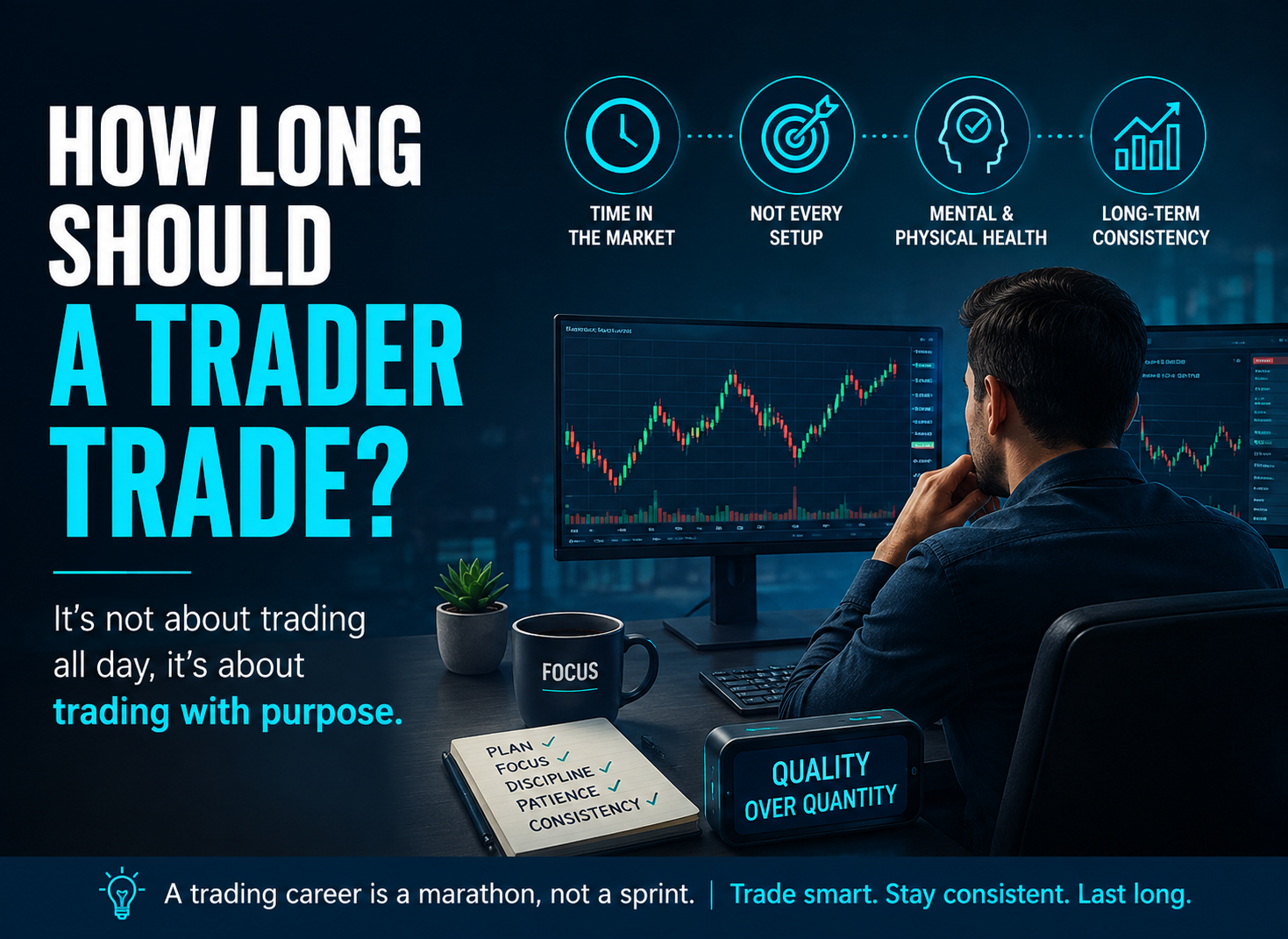
A trader should trade only as long as the market conditions and strategy remain favorable, not for a fixed number of hours.
Many
traders believe that the more time they spend watching charts, the more money
they can make.
But trading does not work like a normal job where more working hours automatically mean more output. In fact, spending too much time in front of the market can sometimes lead to overtrading, emotional decisions and unnecessary losses.
The goal is not to trade more. The goal is to trade when your opportunity appears.
More Screen Time Does Not Mean More Profit
Imagine two traders.
One trader watches the market for eight hours every day. After several hours without finding an opportunity, they become impatient and start creating reasons to enter trades.
Another trader spends 30 minutes analyzing the market, identifies the important levels, sets alerts and waits. If the expected setup does not appear, there is no trade.
Who is trading more professionally?
The trader who takes fewer trades may actually be following a stronger process.
The Market Does Not Pay You for Your Time
If you spend 10 hours watching Gold, the market does not owe you a trade.
Sometimes the best opportunity may appear within the first 15 minutes of your analysis. On another day, there may be no suitable opportunity at all.
Professional trading is about quality of decisions, not quantity of hours.
Why Traders Start Overtrading
The longer traders continuously watch a moving chart, the easier it can become to react emotionally.
A small movement starts looking like a breakout. A normal correction starts looking like a reversal. After a loss, another trade may be opened immediately to recover the money.
One unnecessary trade becomes two, and two can quickly become five.
This is how screen time can turn into overtrading.
Spend More Time Learning, Less Time Executing
There is an important difference between spending time learning trading and spending time placing trades.
A developing trader should spend time studying charts, backtesting strategies, reviewing previous trades, understanding economic events and improving risk management.
But once a trading strategy is clearly defined, execution does not necessarily require sitting in front of the chart throughout the day.
Let Your Setup Decide the Trade
Suppose your strategy requires three specific conditions before entering.
If only two conditions are present, there is no trade.
Whether you have been watching the chart for 10 minutes or five hours should make no difference.
Your trading setup should decide when you enter, not the amount of time you have already spent waiting.
Automation Can Reduce Unnecessary Screen Time
This is also where alerts and trading automation can help.
Instead of continuously watching multiple instruments, traders can create alerts or automated rules that identify when predefined market conditions occur.
Technology can monitor the market while the trader focuses on analysis, learning and decision-making.
Automation does not guarantee profitable trades, but it can help reduce the need to constantly watch charts.
Less Trading Can Sometimes Mean Better Trading
Trading less does not automatically mean earning more, just as trading more does not automatically mean losing more.
The important difference is selectivity.
Taking five high-quality setups may be better than taking fifty trades simply because the market is moving.
Sometimes the most professional trading decision you can make is to do nothing.
Takeaway!
There is no fixed number of hours that every trader should spend trading. It depends on the strategy, timeframe, instrument and individual trading plan.
But one principle is worth remembering:
Spend more time learning. Spend enough time analyzing. Spend less time unnecessarily trading.
At Primexar, we encourage traders to develop structured setups, risk-management rules and disciplined trading habits so that decisions are based on market opportunities rather than the number of hours spent in front of a screen.
But trading does not work like a normal job where more working hours automatically mean more output. In fact, spending too much time in front of the market can sometimes lead to overtrading, emotional decisions and unnecessary losses.
The goal is not to trade more. The goal is to trade when your opportunity appears.
More Screen Time Does Not Mean More Profit
Imagine two traders.
One trader watches the market for eight hours every day. After several hours without finding an opportunity, they become impatient and start creating reasons to enter trades.
Another trader spends 30 minutes analyzing the market, identifies the important levels, sets alerts and waits. If the expected setup does not appear, there is no trade.
Who is trading more professionally?
The trader who takes fewer trades may actually be following a stronger process.
The Market Does Not Pay You for Your Time
If you spend 10 hours watching Gold, the market does not owe you a trade.
Sometimes the best opportunity may appear within the first 15 minutes of your analysis. On another day, there may be no suitable opportunity at all.
Professional trading is about quality of decisions, not quantity of hours.
Why Traders Start Overtrading
The longer traders continuously watch a moving chart, the easier it can become to react emotionally.
A small movement starts looking like a breakout. A normal correction starts looking like a reversal. After a loss, another trade may be opened immediately to recover the money.
One unnecessary trade becomes two, and two can quickly become five.
This is how screen time can turn into overtrading.
Spend More Time Learning, Less Time Executing
There is an important difference between spending time learning trading and spending time placing trades.
A developing trader should spend time studying charts, backtesting strategies, reviewing previous trades, understanding economic events and improving risk management.
But once a trading strategy is clearly defined, execution does not necessarily require sitting in front of the chart throughout the day.
Let Your Setup Decide the Trade
Suppose your strategy requires three specific conditions before entering.
If only two conditions are present, there is no trade.
Whether you have been watching the chart for 10 minutes or five hours should make no difference.
Your trading setup should decide when you enter, not the amount of time you have already spent waiting.
Automation Can Reduce Unnecessary Screen Time
This is also where alerts and trading automation can help.
Instead of continuously watching multiple instruments, traders can create alerts or automated rules that identify when predefined market conditions occur.
Technology can monitor the market while the trader focuses on analysis, learning and decision-making.
Automation does not guarantee profitable trades, but it can help reduce the need to constantly watch charts.
Less Trading Can Sometimes Mean Better Trading
Trading less does not automatically mean earning more, just as trading more does not automatically mean losing more.
The important difference is selectivity.
Taking five high-quality setups may be better than taking fifty trades simply because the market is moving.
Sometimes the most professional trading decision you can make is to do nothing.
Takeaway!
There is no fixed number of hours that every trader should spend trading. It depends on the strategy, timeframe, instrument and individual trading plan.
But one principle is worth remembering:
Spend more time learning. Spend enough time analyzing. Spend less time unnecessarily trading.
At Primexar, we encourage traders to develop structured setups, risk-management rules and disciplined trading habits so that decisions are based on market opportunities rather than the number of hours spent in front of a screen.