Trading Strategies
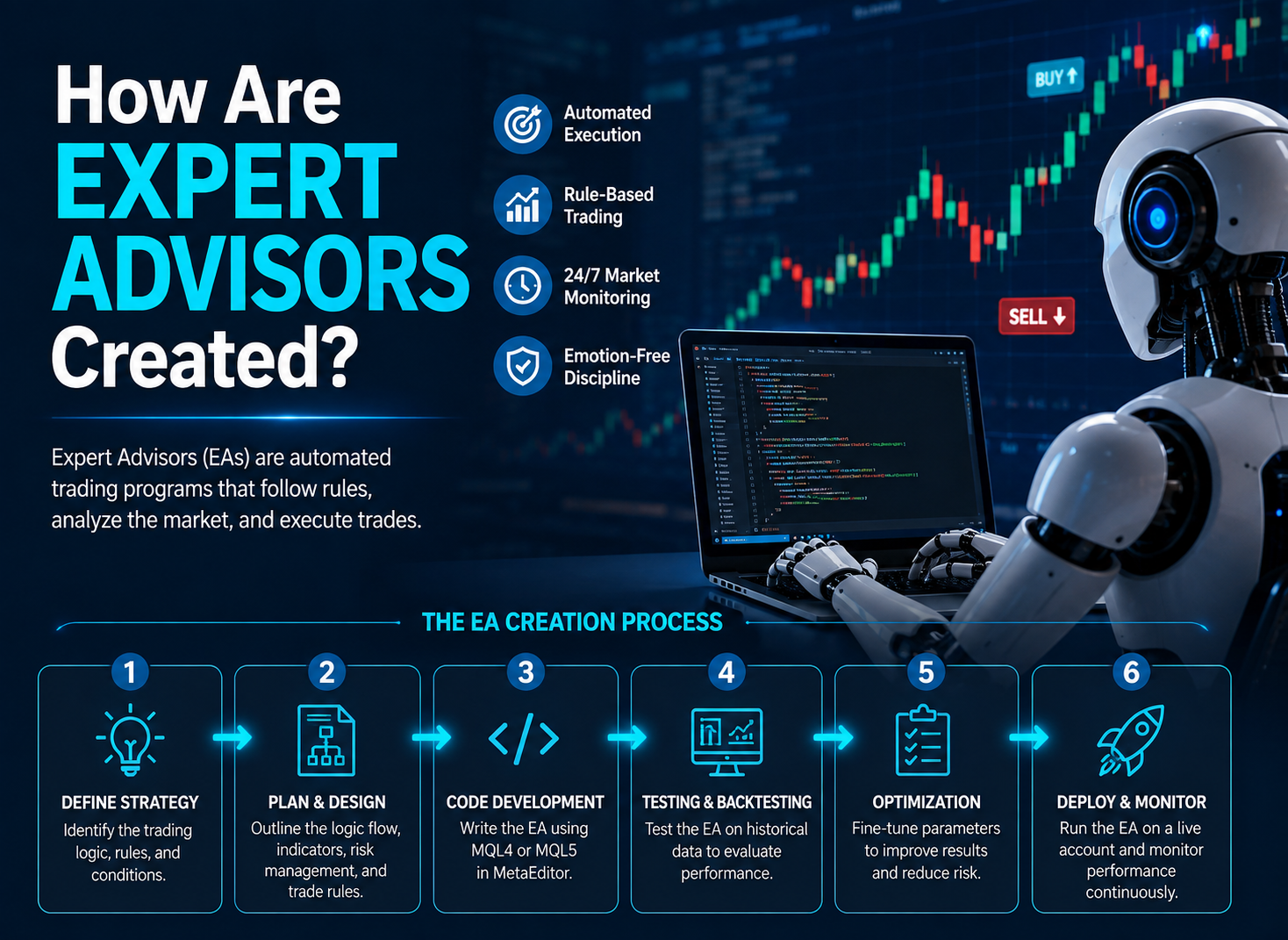
Expert Advisors (EAs) are created by coding trading strategies and rules into automated software that can analyze markets and execute trades.
Have
you ever looked at a trading chart and noticed the same pattern happening again
and again?
It could be two consecutive bullish candles followed by another strong bullish candle. It could happen on a 1-hour chart, 4-hour chart, daily chart, or any other timeframe.
Instead of simply trading the pattern manually every time, ask yourself another question:
Can this trading idea be converted into automation?
That is where the development of an Expert Advisor begins.
The Chart Is Your Starting Point
Before thinking about programming, start with the chart.
Observe how price behaves. Study different market conditions and identify patterns that appear repeatedly.
For example, imagine you notice that whenever three consecutive bullish candles appear, price frequently continues upward during the next candle.
That observation is not yet a trading strategy. It is simply an idea that needs to be researched.
Convert the Pattern Into Rules
Computers cannot understand instructions such as this chart looks bullish.
The idea needs to become specific rules.
For example, Candle 1 must be bullish. Candle 2 must be bullish. Candle 3 must be bullish. If the next candle breaks the high of Candle 3, open a Buy position.
Now the chart observation has become a measurable set of conditions.
The same process can be applied to bearish candles, breakouts, moving averages, support and resistance, volatility, time-based strategies, or many other measurable trading conditions.
Add Risk and Trade Management
Finding an entry is only one part of creating an Expert Advisor.
You also need to define what happens after the trade opens.
Where should the Stop Loss be placed?
Where should the Take Profit be placed?
What volume should be traded?
Should the position move to Break-Even after reaching a certain profit?
Should the EA stop trading after reaching a predefined daily loss?
Every decision that you normally make manually needs to be clearly defined if you want the system to automate it.
Build the Expert Advisor
Once your rules are clear, they can be translated into programming logic for platforms such as MetaTrader.
The Expert Advisor can then continuously monitor the market. When the predefined conditions occur, it can execute or manage trades according to those instructions.
This is the fundamental concept behind trading automation: observe, define, program and execute.
Backtesting Comes Before Trust
Creating an EA does not mean you have created a profitable strategy.
The next important step is backtesting.
Suppose your three-candle pattern occurred 500 times over several years of historical data. How many trades were profitable? How many lost? What was the maximum drawdown? Did it perform differently in trending and sideways markets? What happened when volatility increased?
Backtesting helps answer these questions.
A strategy that looks impressive on 10 examples may produce completely different results when tested across hundreds or thousands of historical situations.
Improve What the Data Shows You
Backtesting may reveal that your original idea needs improvement.
Perhaps the pattern works better on the 4-hour chart than the 1-hour chart. Maybe it performs better during particular market conditions. Perhaps the Stop Loss is too small, the Take Profit is unrealistic, or the volume creates excessive risk.
Modify the rules and test again.
This continuous process of observation, testing and improvement is an important part of developing an automated trading system.
Conclusion
An Expert Advisor does not have to begin with complicated programming.
It can begin with something as simple as observing a repeated behaviour on a chart.
Observe the pattern. Define the rules. Automate the logic. Backtest the strategy. Analyze the results. Improve it.
The chart can give you the idea. Research can validate the idea. Automation can execute the idea consistently.
At Primexar, we help traders understand how their trading observations and strategies can be transformed into structured automation and tested before being considered for real-market application.
It could be two consecutive bullish candles followed by another strong bullish candle. It could happen on a 1-hour chart, 4-hour chart, daily chart, or any other timeframe.
Instead of simply trading the pattern manually every time, ask yourself another question:
Can this trading idea be converted into automation?
That is where the development of an Expert Advisor begins.
The Chart Is Your Starting Point
Before thinking about programming, start with the chart.
Observe how price behaves. Study different market conditions and identify patterns that appear repeatedly.
For example, imagine you notice that whenever three consecutive bullish candles appear, price frequently continues upward during the next candle.
That observation is not yet a trading strategy. It is simply an idea that needs to be researched.
Convert the Pattern Into Rules
Computers cannot understand instructions such as this chart looks bullish.
The idea needs to become specific rules.
For example, Candle 1 must be bullish. Candle 2 must be bullish. Candle 3 must be bullish. If the next candle breaks the high of Candle 3, open a Buy position.
Now the chart observation has become a measurable set of conditions.
The same process can be applied to bearish candles, breakouts, moving averages, support and resistance, volatility, time-based strategies, or many other measurable trading conditions.
Add Risk and Trade Management
Finding an entry is only one part of creating an Expert Advisor.
You also need to define what happens after the trade opens.
Where should the Stop Loss be placed?
Where should the Take Profit be placed?
What volume should be traded?
Should the position move to Break-Even after reaching a certain profit?
Should the EA stop trading after reaching a predefined daily loss?
Every decision that you normally make manually needs to be clearly defined if you want the system to automate it.
Build the Expert Advisor
Once your rules are clear, they can be translated into programming logic for platforms such as MetaTrader.
The Expert Advisor can then continuously monitor the market. When the predefined conditions occur, it can execute or manage trades according to those instructions.
This is the fundamental concept behind trading automation: observe, define, program and execute.
Backtesting Comes Before Trust
Creating an EA does not mean you have created a profitable strategy.
The next important step is backtesting.
Suppose your three-candle pattern occurred 500 times over several years of historical data. How many trades were profitable? How many lost? What was the maximum drawdown? Did it perform differently in trending and sideways markets? What happened when volatility increased?
Backtesting helps answer these questions.
A strategy that looks impressive on 10 examples may produce completely different results when tested across hundreds or thousands of historical situations.
Improve What the Data Shows You
Backtesting may reveal that your original idea needs improvement.
Perhaps the pattern works better on the 4-hour chart than the 1-hour chart. Maybe it performs better during particular market conditions. Perhaps the Stop Loss is too small, the Take Profit is unrealistic, or the volume creates excessive risk.
Modify the rules and test again.
This continuous process of observation, testing and improvement is an important part of developing an automated trading system.
Conclusion
An Expert Advisor does not have to begin with complicated programming.
It can begin with something as simple as observing a repeated behaviour on a chart.
Observe the pattern. Define the rules. Automate the logic. Backtest the strategy. Analyze the results. Improve it.
The chart can give you the idea. Research can validate the idea. Automation can execute the idea consistently.
At Primexar, we help traders understand how their trading observations and strategies can be transformed into structured automation and tested before being considered for real-market application.