Analysis
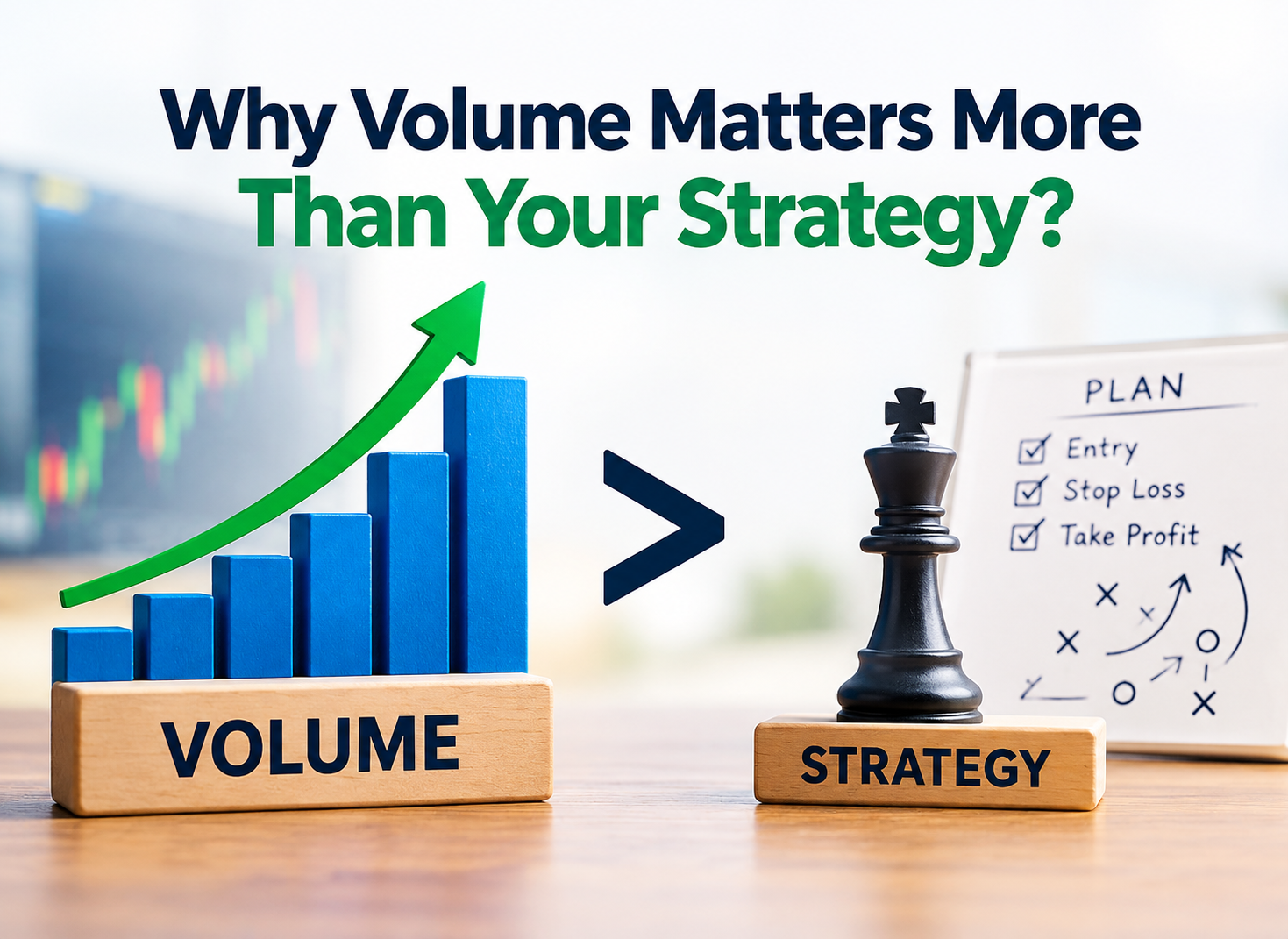
A great strategy means little without enough volume. Discover why consistent execution, higher activity, and data-driven volume can have a bigger impact on growth than strategy alone.
A
Good Strategy Alone Is Not Enough
When traders enter the financial markets, most of their attention goes toward finding the best strategy. They search for indicators, candlestick patterns, support and resistance, Smart Money concepts, AI tools and different entry techniques. But there is another factor that can be even more important than the strategy itself: trading volume. You may have an excellent entry strategy, but if your position size is too large for your capital, just a few losing trades can create serious damage. On the other hand, when the volume is appropriate for the account, the trader has much more ability to absorb normal market fluctuations and manage risk.
Think about two traders who have the same account balance and take exactly the same Gold trade at exactly the same entry price. One trader opens 0.01 lot while the other opens 1.00 lot. The market moves against both of them by exactly the same distance. Their analysis is the same, their entry is the same, and the market movement is the same, but the financial impact on their accounts is completely different. The reason is simply volume. This is why volume should never be treated as just another number in the order window. It directly determines how strongly market movement affects your capital.
Your Capital and Volume Must Work Together
Imagine you have a $5,000 trading account and you trade Gold with a very small position such as 0.01 lot. Compared with using 0.50 or 1.00 lot on the same account, normal Gold price movements will generally have a much smaller monetary impact. This does not mean that a 0.01 lot makes the trade risk-free or that you no longer need a Stop-Loss. Any market can make an extreme or prolonged move. The important point is that smaller volume gives the account greater tolerance for adverse market movement.
Now imagine the same $5,000 account trading an unnecessarily large volume. A market movement that would have produced only a manageable fluctuation with 0.01 lot could create a substantial drawdown with a much larger position. Nothing about the trading strategy changed. The trader entered at the same place, and the market moved exactly the same distance. The only difference was the position size. This demonstrates why a good strategy with poor volume management can still produce a bad outcome.
Market Price and Volatility Also Matter
Volume should not be selected only by looking at the account balance. Traders should also consider the instrument they are trading and its current volatility. For example, when Gold was trading around $2,000, its typical movement and market conditions could have been very different from periods when Gold trades at substantially higher prices. Using the same assumptions forever simply because they worked when Gold was around $2,000 may not be appropriate when the market's price level and volatility have changed significantly.
This is where volatility measurements such as ATR — Average True Range become useful. ATR can help us understand how much an instrument has been moving recently. If Gold's average movement increases significantly, the trader should understand that the same position size may now experience larger monetary fluctuations. Therefore, instead of saying, I always trade Gold with this volume, a better approach is to consider the account balance, current volatility, Stop-Loss distance and acceptable risk before selecting the volume.
The same principle applies to major currency pairs. For example, a trader with around $2,000 might consider 0.01 lot as a conservative starting illustration for a major currency pair, but it should not become a universal rule that $2,000 always equals 0.01 lot. A 0.01-lot EURUSD position with a 20-pip Stop-Loss carries a very different potential loss from the same 0.01-lot position with a 200-pip Stop-Loss. This is why the Stop-Loss distance and instrument specifications must also be considered.
Start With Risk, Not Lot Size
Instead of asking, What volume should I trade?, a more professional question is, How much of my account am I prepared to lose if this trade is wrong? Once the trader decides the acceptable risk, the Stop-Loss distance and instrument specifications can be used to determine a more appropriate position size. In simple terms, the thinking should be: Capital → Acceptable Risk → Stop Loss Distance → Volume.
Unfortunately, many traders do exactly the opposite. They decide that they want to trade 0.10 lot, 0.50 lot or 1.00 lot first and only afterwards think about the risk. Sometimes the volume is chosen simply because the available margin allows the trade to be opened. But available margin is not the same as acceptable risk. Leverage may allow you to control a much larger market position, but that does not mean your account should take that exposure.
Strategy Finds the Opportunity, Volume Controls the Exposure
Every strategy will eventually experience losing trades. There is no trading method that can guarantee every entry will be correct. This is why the survival of a trading account cannot depend only on finding a high winning percentage. Imagine one strategy wins 80% of its trades but uses excessive volume, while another wins 60% but follows disciplined position sizing and controlled risk. We cannot decide which is better simply by looking at the win rate. We also need to know how much is gained when the strategy wins and how much is lost when it fails.
A strategy tells you where an opportunity may exist, but volume determines how much of your capital you expose to that opportunity. If the position size is controlled, a losing trade can remain part of normal trading. If the volume is excessive, one ordinary losing trade can become an account-threatening event. This is why professional trading should focus not only on being right, but also on controlling what happens when you are wrong.
Protect the Account Before Thinking About Profit
At Primexar, we encourage traders not to begin every trade by asking, How much can I make? Start by asking, How much am I prepared to lose if my analysis is wrong? Once that is clear, determine the Stop-Loss, calculate an appropriate volume and then evaluate the potential reward. Strategy, technical analysis, automation and AI can all help traders improve their decision-making, but none of these can compensate for uncontrolled position sizing.
You don't necessarily need the biggest trade to become a better trader. You need a position size that your account can reasonably handle when the market moves against your expectation. Strategy determines the opportunity, volume determines the exposure, and risk management determines whether you survive long enough to take the next opportunity.
When traders enter the financial markets, most of their attention goes toward finding the best strategy. They search for indicators, candlestick patterns, support and resistance, Smart Money concepts, AI tools and different entry techniques. But there is another factor that can be even more important than the strategy itself: trading volume. You may have an excellent entry strategy, but if your position size is too large for your capital, just a few losing trades can create serious damage. On the other hand, when the volume is appropriate for the account, the trader has much more ability to absorb normal market fluctuations and manage risk.
Think about two traders who have the same account balance and take exactly the same Gold trade at exactly the same entry price. One trader opens 0.01 lot while the other opens 1.00 lot. The market moves against both of them by exactly the same distance. Their analysis is the same, their entry is the same, and the market movement is the same, but the financial impact on their accounts is completely different. The reason is simply volume. This is why volume should never be treated as just another number in the order window. It directly determines how strongly market movement affects your capital.
Your Capital and Volume Must Work Together
Imagine you have a $5,000 trading account and you trade Gold with a very small position such as 0.01 lot. Compared with using 0.50 or 1.00 lot on the same account, normal Gold price movements will generally have a much smaller monetary impact. This does not mean that a 0.01 lot makes the trade risk-free or that you no longer need a Stop-Loss. Any market can make an extreme or prolonged move. The important point is that smaller volume gives the account greater tolerance for adverse market movement.
Now imagine the same $5,000 account trading an unnecessarily large volume. A market movement that would have produced only a manageable fluctuation with 0.01 lot could create a substantial drawdown with a much larger position. Nothing about the trading strategy changed. The trader entered at the same place, and the market moved exactly the same distance. The only difference was the position size. This demonstrates why a good strategy with poor volume management can still produce a bad outcome.
Market Price and Volatility Also Matter
Volume should not be selected only by looking at the account balance. Traders should also consider the instrument they are trading and its current volatility. For example, when Gold was trading around $2,000, its typical movement and market conditions could have been very different from periods when Gold trades at substantially higher prices. Using the same assumptions forever simply because they worked when Gold was around $2,000 may not be appropriate when the market's price level and volatility have changed significantly.
This is where volatility measurements such as ATR — Average True Range become useful. ATR can help us understand how much an instrument has been moving recently. If Gold's average movement increases significantly, the trader should understand that the same position size may now experience larger monetary fluctuations. Therefore, instead of saying, I always trade Gold with this volume, a better approach is to consider the account balance, current volatility, Stop-Loss distance and acceptable risk before selecting the volume.
The same principle applies to major currency pairs. For example, a trader with around $2,000 might consider 0.01 lot as a conservative starting illustration for a major currency pair, but it should not become a universal rule that $2,000 always equals 0.01 lot. A 0.01-lot EURUSD position with a 20-pip Stop-Loss carries a very different potential loss from the same 0.01-lot position with a 200-pip Stop-Loss. This is why the Stop-Loss distance and instrument specifications must also be considered.
Start With Risk, Not Lot Size
Instead of asking, What volume should I trade?, a more professional question is, How much of my account am I prepared to lose if this trade is wrong? Once the trader decides the acceptable risk, the Stop-Loss distance and instrument specifications can be used to determine a more appropriate position size. In simple terms, the thinking should be: Capital → Acceptable Risk → Stop Loss Distance → Volume.
Unfortunately, many traders do exactly the opposite. They decide that they want to trade 0.10 lot, 0.50 lot or 1.00 lot first and only afterwards think about the risk. Sometimes the volume is chosen simply because the available margin allows the trade to be opened. But available margin is not the same as acceptable risk. Leverage may allow you to control a much larger market position, but that does not mean your account should take that exposure.
Strategy Finds the Opportunity, Volume Controls the Exposure
Every strategy will eventually experience losing trades. There is no trading method that can guarantee every entry will be correct. This is why the survival of a trading account cannot depend only on finding a high winning percentage. Imagine one strategy wins 80% of its trades but uses excessive volume, while another wins 60% but follows disciplined position sizing and controlled risk. We cannot decide which is better simply by looking at the win rate. We also need to know how much is gained when the strategy wins and how much is lost when it fails.
A strategy tells you where an opportunity may exist, but volume determines how much of your capital you expose to that opportunity. If the position size is controlled, a losing trade can remain part of normal trading. If the volume is excessive, one ordinary losing trade can become an account-threatening event. This is why professional trading should focus not only on being right, but also on controlling what happens when you are wrong.
Protect the Account Before Thinking About Profit
At Primexar, we encourage traders not to begin every trade by asking, How much can I make? Start by asking, How much am I prepared to lose if my analysis is wrong? Once that is clear, determine the Stop-Loss, calculate an appropriate volume and then evaluate the potential reward. Strategy, technical analysis, automation and AI can all help traders improve their decision-making, but none of these can compensate for uncontrolled position sizing.
You don't necessarily need the biggest trade to become a better trader. You need a position size that your account can reasonably handle when the market moves against your expectation. Strategy determines the opportunity, volume determines the exposure, and risk management determines whether you survive long enough to take the next opportunity.