Trading Strategies
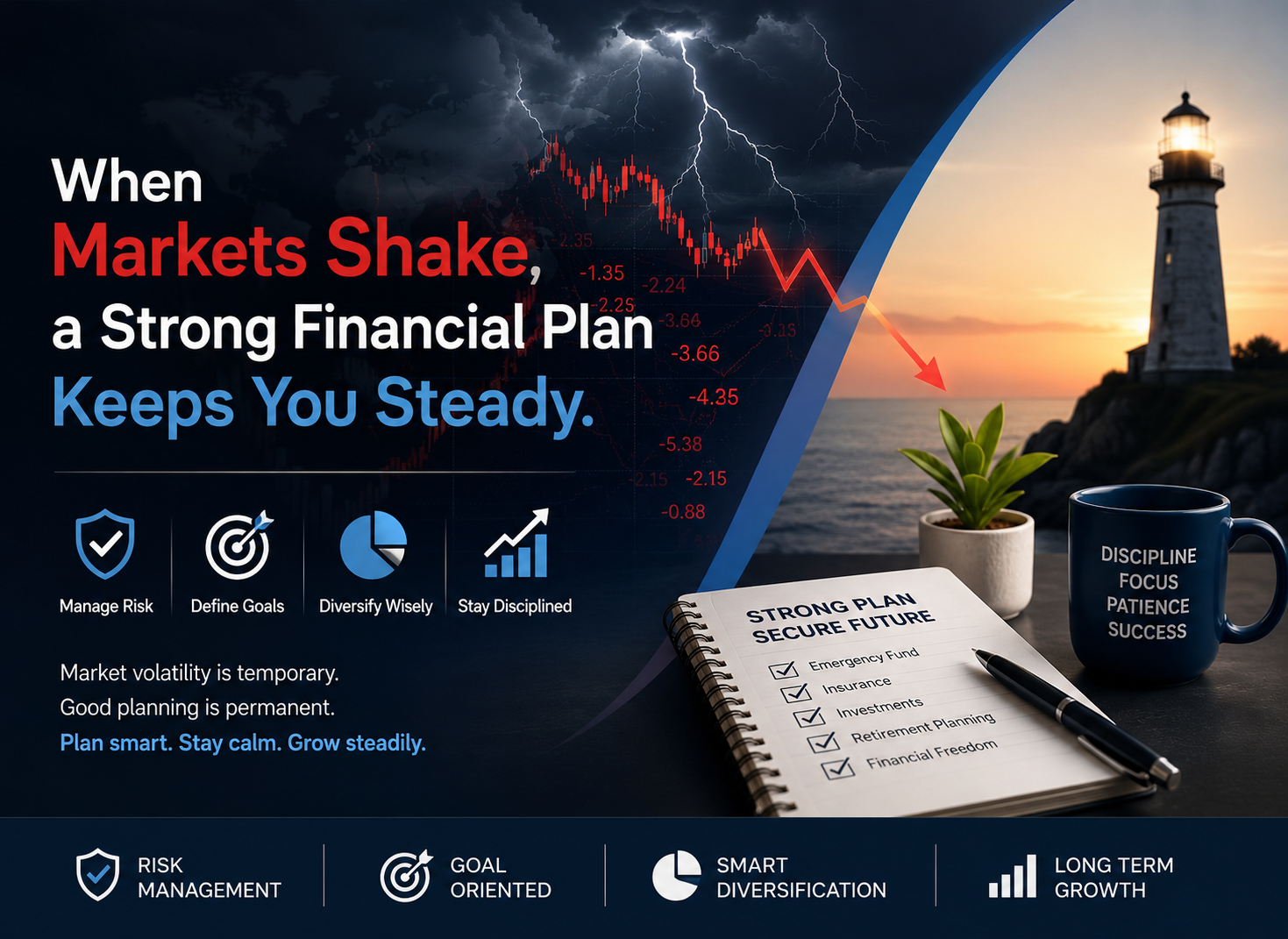
Market volatility is inevitable, but a well-built financial plan can help you stay focused and confident. By preparing for uncertainty, managing risks, and staying committed to your goals, you can navigate market ups and downs with greater peace of mind.
Artificial intelligence is booming. Technology companies are investing
billions, and AI-related shares continue to lead parts of the global stock
market. Yet concerns are growing that market valuations may have moved too far,
too quickly. The ten largest companies now represent more than 40% of the
S&P 500’s total value, showing how dependent the market has become on a
relatively small group of businesses.
At the same time, geopolitical conflicts continue to disrupt energy supplies and global trade. Oil prices have again crossed $100 per barrel amid renewed concerns over important shipping routes. Higher energy and transportation costs may eventually affect almost everything from food and manufacturing to travel and household expenses.
Inflation also remains a major concern. The IMF expects global headline inflation to rise from 4.1% in 2025 to 4.7% in 2026 before easing in 2027. Meanwhile, international stock markets are experiencing pressure from war, rising oil prices, inflation concerns and uncertainty over future interest rates
Employment is not completely secure either. Technology companies announced 139,156 job cuts during the first half of 2026, 83% higher than during the same period in 2025. AI, automation, restructuring and cost reduction are changing the employment landscape.
All these developments lead to one important question:
If a financial crisis reaches our personal lives, are we prepared?
Income Alone Is Not Financial Security
Many people believe that a stable salary is enough. However, a salary depends on continued employment, and employment depends on business and economic conditions that individuals cannot always control.
A sudden job loss, medical expense, business slowdown or family emergency can immediately create financial pressure. If all our income has already been spent and we have no liquid savings, we may be forced to borrow money or sell investments at the wrong time.
This is why earning money is only the first step. The next steps are saving, maintaining emergency liquidity and investing consistently.
Liquidity Must Come Before Investment
Investment is essential for long-term wealth creation, but it cannot replace an emergency fund.
Before investing heavily, consider maintaining enough easily accessible money to cover approximately three to six months of essential living expenses. Someone with irregular income, business responsibilities or several dependants may require a larger reserve.
Emergency money should generally remain in highly liquid and relatively stable places, such as:
At the same time, geopolitical conflicts continue to disrupt energy supplies and global trade. Oil prices have again crossed $100 per barrel amid renewed concerns over important shipping routes. Higher energy and transportation costs may eventually affect almost everything from food and manufacturing to travel and household expenses.
Inflation also remains a major concern. The IMF expects global headline inflation to rise from 4.1% in 2025 to 4.7% in 2026 before easing in 2027. Meanwhile, international stock markets are experiencing pressure from war, rising oil prices, inflation concerns and uncertainty over future interest rates
Employment is not completely secure either. Technology companies announced 139,156 job cuts during the first half of 2026, 83% higher than during the same period in 2025. AI, automation, restructuring and cost reduction are changing the employment landscape.
All these developments lead to one important question:
If a financial crisis reaches our personal lives, are we prepared?
Income Alone Is Not Financial Security
Many people believe that a stable salary is enough. However, a salary depends on continued employment, and employment depends on business and economic conditions that individuals cannot always control.
A sudden job loss, medical expense, business slowdown or family emergency can immediately create financial pressure. If all our income has already been spent and we have no liquid savings, we may be forced to borrow money or sell investments at the wrong time.
This is why earning money is only the first step. The next steps are saving, maintaining emergency liquidity and investing consistently.
Liquidity Must Come Before Investment
Investment is essential for long-term wealth creation, but it cannot replace an emergency fund.
Before investing heavily, consider maintaining enough easily accessible money to cover approximately three to six months of essential living expenses. Someone with irregular income, business responsibilities or several dependants may require a larger reserve.
Emergency money should generally remain in highly liquid and relatively stable places, such as:
• A savings account
• A short-term or fixed deposit
• A money-market instrument
• Another regulated, easily accessible cash-equivalent product
The objective of this money is not to generate the highest return. Its purpose is to protect you during an emergency.
Liquidity protects the present. Investment builds the future. We need both.
Begin With Just 10%
You do not need a large amount of capital to begin building financial discipline. Start by setting aside at least 10% of your income every month.
If monthly investment is difficult because your income is irregular, you could invest quarterly instead. The amount is important, but consistency is even more important.
The objective of this money is not to generate the highest return. Its purpose is to protect you during an emergency.
Liquidity protects the present. Investment builds the future. We need both.
Begin With Just 10%
You do not need a large amount of capital to begin building financial discipline. Start by setting aside at least 10% of your income every month.
If monthly investment is difficult because your income is irregular, you could invest quarterly instead. The amount is important, but consistency is even more important.
For example, if someone earns $3,000 per month, they could set aside $300:
• The first portion can build the emergency fund.
• Once the emergency reserve is sufficient, the money can be directed toward long-term investments.
• As income increases, the contribution could gradually rise from 10% to 15% or 20%.
The best time to create this habit is not after the next crisis. It is while income is still available.
Never Depend on a Single Asset
Segregation, or more accurately, diversification, means distributing money among different asset classes instead of depending entirely on one company, one market or one idea.
An illustrative allocation for a moderate long-term investor could be:
The best time to create this habit is not after the next crisis. It is while income is still available.
Never Depend on a Single Asset
Segregation, or more accurately, diversification, means distributing money among different asset classes instead of depending entirely on one company, one market or one idea.
A diversified
plan might include:
|
Asset category |
Possible purpose |
|
Cash and liquid savings |
Emergencies and short-term needs |
|
Bonds or fixed-income products |
Stability and income |
|
Broad equity funds |
Long-term capital growth |
|
Gold |
Diversification during uncertainty |
|
Property or REITs |
Real-asset exposure and possible income |
|
International investments |
Reducing dependence on one country |
|
High-risk assets |
Limited exposure to higher-growth opportunities |
An illustrative allocation for a moderate long-term investor could be:
• 20% cash and short-term reserves
• 25% bonds or fixed-income investments
• 35% diversified equity funds
• 10% gold
• 10% property-related or other investments
This is only an example, not a universal recommendation. The correct allocation depends on age, income, responsibilities, debt, objectives, time horizon and ability to tolerate losses.
Diversification Is Especially Important During an AI Boom
AI may transform the world and create enormous long-term value. However, a powerful technology does not automatically make every AI-related investment reasonably priced.
Current estimates indicate that AI-related companies have gained approximately $27 trillion in market value since November 2022. Goldman Sachs Research has estimated the present value of potential additional AI-related corporate profits at roughly $9 trillion. This difference does not prove that an AI bubble will burst, but it shows why investors should examine valuations carefully.
Investors do not necessarily have to avoid AI. They should avoid allowing excitement about one theme to dominate their entire portfolio.
Innovation can continue even while share prices decline. A good company can still become an unsuitable investment if purchased at an unreasonable valuation.
What Happens If We Do Nothing?
Inflation gradually reduces the purchasing power of idle money. At the same time, spending everything we earn leaves us exposed when an emergency occurs.
Without savings and investments:
This is only an example, not a universal recommendation. The correct allocation depends on age, income, responsibilities, debt, objectives, time horizon and ability to tolerate losses.
Diversification Is Especially Important During an AI Boom
AI may transform the world and create enormous long-term value. However, a powerful technology does not automatically make every AI-related investment reasonably priced.
Current estimates indicate that AI-related companies have gained approximately $27 trillion in market value since November 2022. Goldman Sachs Research has estimated the present value of potential additional AI-related corporate profits at roughly $9 trillion. This difference does not prove that an AI bubble will burst, but it shows why investors should examine valuations carefully.
Investors do not necessarily have to avoid AI. They should avoid allowing excitement about one theme to dominate their entire portfolio.
Innovation can continue even while share prices decline. A good company can still become an unsuitable investment if purchased at an unreasonable valuation.
What Happens If We Do Nothing?
Inflation gradually reduces the purchasing power of idle money. At the same time, spending everything we earn leaves us exposed when an emergency occurs.
Without savings and investments:
• A job loss can quickly become a debt crisis.
• A medical emergency can force the sale of valuable assets.
• Inflation can reduce future purchasing power.
• Retirement may depend completely on continued employment or family support.
• Market opportunities may be missed because no capital is available.
Investing does not guarantee protection from every crisis. Markets can fall, and investments can lose value. However, a combination of emergency liquidity, controlled debt, diversification and consistent long-term investing can improve financial resilience.
The Market Will Always Give Us a Reason to Wait
There will always be uncertainty: war, inflation, recession fears, interest-rate changes, job losses or concerns about a market bubble.
Waiting for a world without risk may mean waiting forever.
The objective is not to predict every crisis correctly. It is to build a financial structure capable of surviving different conditions. Begin with what you can afford, maintain accessible emergency funds, invest regularly and avoid concentrating everything in one asset.
You cannot control the next war, oil-price shock, market correction or employment disruption. But you can control how much you save, how you invest and how well-prepared you are.
That preparation may become one of the most valuable investments you ever make.
Disclaimer: This article is for educational purposes only and does not constitute personal financial or investment advice. All investments involve risk. Consider your financial position and consult a qualified professional before making investment decisions.
Investing does not guarantee protection from every crisis. Markets can fall, and investments can lose value. However, a combination of emergency liquidity, controlled debt, diversification and consistent long-term investing can improve financial resilience.
The Market Will Always Give Us a Reason to Wait
There will always be uncertainty: war, inflation, recession fears, interest-rate changes, job losses or concerns about a market bubble.
Waiting for a world without risk may mean waiting forever.
The objective is not to predict every crisis correctly. It is to build a financial structure capable of surviving different conditions. Begin with what you can afford, maintain accessible emergency funds, invest regularly and avoid concentrating everything in one asset.
You cannot control the next war, oil-price shock, market correction or employment disruption. But you can control how much you save, how you invest and how well-prepared you are.
That preparation may become one of the most valuable investments you ever make.
Disclaimer: This article is for educational purposes only and does not constitute personal financial or investment advice. All investments involve risk. Consider your financial position and consult a qualified professional before making investment decisions.