Trading Strategies
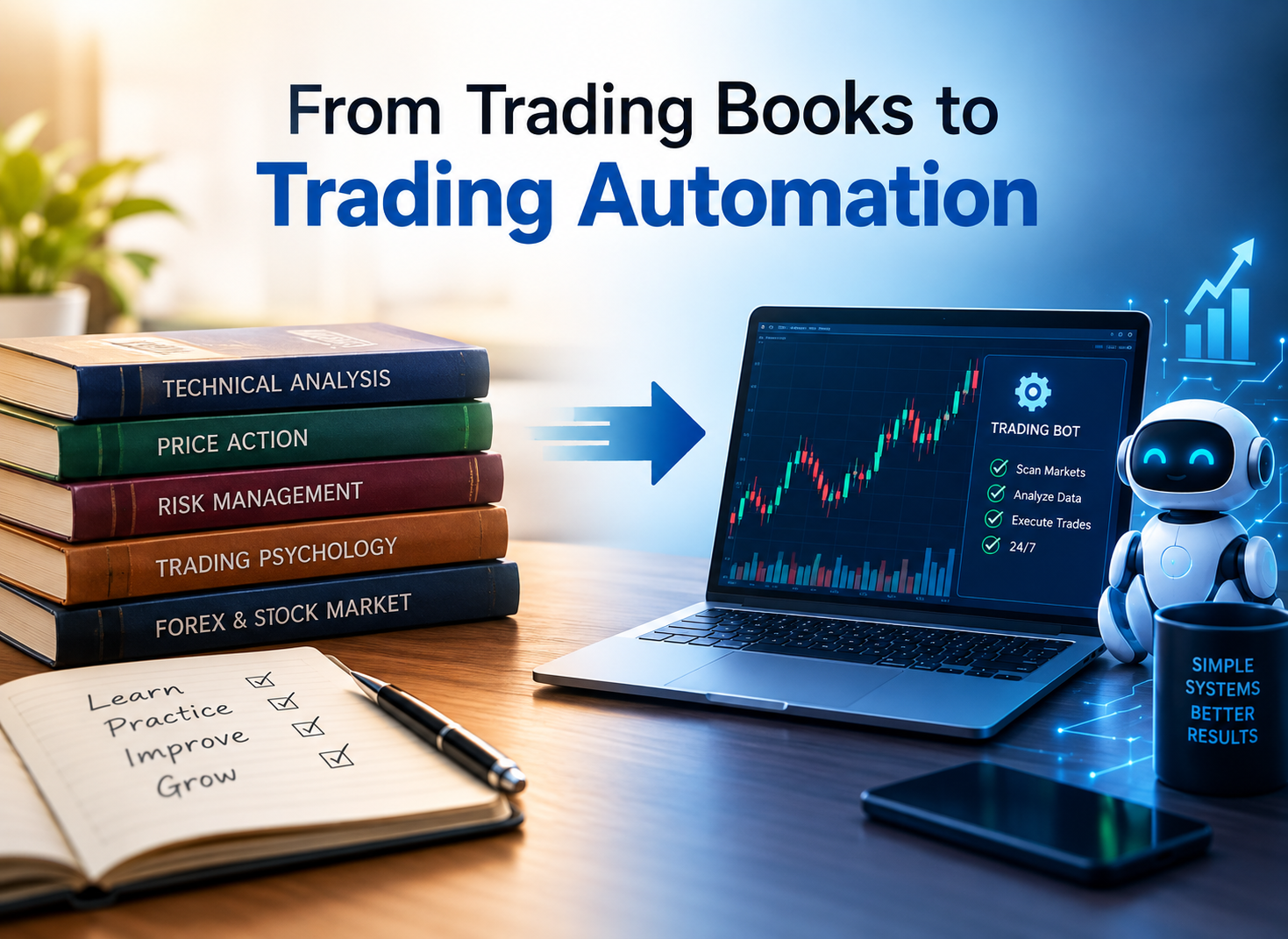
Trading has evolved from traditional strategies to automated systems that analyze markets, generate signals, and execute trades quickly and consistently.
Don't
Just Read a Trading Book — Test What You Learn
Trading books can introduce us to strategies, candlestick patterns, market psychology, risk management and ideas developed by experienced traders. But simply finishing a trading book does not automatically make someone a better trader. The real value begins when you take an idea from the book, understand it, find it on the chart and test whether it actually works under different market conditions.
At Primexar, we encourage traders to follow a simple learning process: Read → Understand → Find It on the Chart → Define the Rules → Backtest with Different Inputs → Automate → Evaluate.
Read and Understand the Idea
When reading a Forex or trading book, don't focus only on finishing chapters. Look for concepts that can actually be applied. It could be a breakout method, candlestick reversal, trend-following concept, support and resistance technique, volatility condition or risk-management rule. Once you find something interesting, stop and understand why the author believes that particular setup works.
The next step is to open the chart and search for the same behaviour. Don't look at only two or three successful examples. Go backwards through the chart and observe where the setup worked, where it failed and under what market conditions the behaviour changed. The chart should become part of your learning process.
Convert the Idea into Clear Rules
An idea becomes much more useful when it can be explained as a rule. Instead of saying, buy when the market looks bullish, define exactly what bullish means. How many candles? What timeframe? How large should the movement be? Where is the entry? Where is the Stop Loss? Where is the Take Profit? What happens when the market moves against the position?
If the rules cannot be clearly defined, it becomes difficult to test them consistently. Once the conditions are measurable, however, the same idea can potentially be converted into an Expert Advisor and tested across much larger amounts of historical data.
Backtesting Is Not Just Pressing the Start Button
This is where many traders make a mistake. They create one strategy, select one set of inputs, run one backtest, and immediately decide whether the strategy is good or bad. Proper backtesting should go further.
Imagine a strategy uses ATR. Instead of testing only ATR 14, you might compare ATR 7, ATR 14 and ATR 21. If the strategy uses a Take Profit and Stop Loss, you can test different combinations. If it uses a timeframe, compare M15, H1, H4 or Daily where appropriate. You may also test different trading sessions, entry distances, filters, risk settings or other parameters that form part of the strategy.
The purpose is not to keep changing settings until you find one historical result that looks profitable. That can lead to overfitting. The objective is to understand how the strategy behaves when its inputs and market conditions change.
A stronger strategy should not depend entirely on one perfect combination of settings from one particular historical period.
Test Different Market Conditions
A strategy may perform very well when the market is trending but struggle when the market moves sideways. Another strategy may work during normal volatility but experience difficulties during extremely volatile periods. This is why backtesting should include different historical conditions rather than focusing only on the period that produces the best result.
Ask practical questions. What happens if volatility increases? What happens if the Take Profit is smaller? What happens if the Stop Loss is larger? What happens when the timeframe changes? What happens during a prolonged trend or a horizontal market?
Every input change teaches you something about the behaviour of the strategy.
From Rules to Automation
Once the idea has clear rules, automation becomes much easier. An Expert Advisor does not need to feel fear, excitement or hesitation. It simply follows the conditions it has been programmed to follow.
This is one of the powerful connections between trading education and automation. A concept that originally came from a trading book can become a chart observation. The observation can become a rule. The rule can become an EA. The EA can then be backtested thousands of times under different settings and historical conditions.
But automation does not turn a weak strategy into a successful one. It simply allows the rules to be executed and tested more consistently.
Evaluate Before You Trade
After backtesting, don't look only at the final profit. Look at the complete behaviour of the strategy. How frequently did it trade? How large were the losses? What was the drawdown? How did it behave during difficult periods? Did changing the inputs completely change the result? Did the strategy work across different conditions, or only during one specific period?
These questions can be more valuable than simply asking, How much profit did the backtest make?
Historical results cannot guarantee future performance, but testing can help traders understand the strengths, weaknesses and limitations of an idea before considering real capital.
Turn Knowledge into Something You Can Test
At Primexar, we believe a trading book should not simply sit on a shelf after you finish reading it. Take one useful idea from it and bring that idea to the chart.
Read it. Understand it. Find it. Define it. Change the inputs. Backtest it. Automate it. Evaluate it.
You don't need to accept every trading idea simply because it appears in a book. You also don't need to reject an idea because it failed in your first test.
Learn how to test it properly.
Because the real value of trading education is not how many books you have finished.
It is how much of what you learned you can understand, test and apply with discipline.
Add a practical backtesting checklist. Clarify the input-variation testing method
Trading books can introduce us to strategies, candlestick patterns, market psychology, risk management and ideas developed by experienced traders. But simply finishing a trading book does not automatically make someone a better trader. The real value begins when you take an idea from the book, understand it, find it on the chart and test whether it actually works under different market conditions.
At Primexar, we encourage traders to follow a simple learning process: Read → Understand → Find It on the Chart → Define the Rules → Backtest with Different Inputs → Automate → Evaluate.
Read and Understand the Idea
When reading a Forex or trading book, don't focus only on finishing chapters. Look for concepts that can actually be applied. It could be a breakout method, candlestick reversal, trend-following concept, support and resistance technique, volatility condition or risk-management rule. Once you find something interesting, stop and understand why the author believes that particular setup works.
The next step is to open the chart and search for the same behaviour. Don't look at only two or three successful examples. Go backwards through the chart and observe where the setup worked, where it failed and under what market conditions the behaviour changed. The chart should become part of your learning process.
Convert the Idea into Clear Rules
An idea becomes much more useful when it can be explained as a rule. Instead of saying, buy when the market looks bullish, define exactly what bullish means. How many candles? What timeframe? How large should the movement be? Where is the entry? Where is the Stop Loss? Where is the Take Profit? What happens when the market moves against the position?
If the rules cannot be clearly defined, it becomes difficult to test them consistently. Once the conditions are measurable, however, the same idea can potentially be converted into an Expert Advisor and tested across much larger amounts of historical data.
Backtesting Is Not Just Pressing the Start Button
This is where many traders make a mistake. They create one strategy, select one set of inputs, run one backtest, and immediately decide whether the strategy is good or bad. Proper backtesting should go further.
Imagine a strategy uses ATR. Instead of testing only ATR 14, you might compare ATR 7, ATR 14 and ATR 21. If the strategy uses a Take Profit and Stop Loss, you can test different combinations. If it uses a timeframe, compare M15, H1, H4 or Daily where appropriate. You may also test different trading sessions, entry distances, filters, risk settings or other parameters that form part of the strategy.
The purpose is not to keep changing settings until you find one historical result that looks profitable. That can lead to overfitting. The objective is to understand how the strategy behaves when its inputs and market conditions change.
A stronger strategy should not depend entirely on one perfect combination of settings from one particular historical period.
Test Different Market Conditions
A strategy may perform very well when the market is trending but struggle when the market moves sideways. Another strategy may work during normal volatility but experience difficulties during extremely volatile periods. This is why backtesting should include different historical conditions rather than focusing only on the period that produces the best result.
Ask practical questions. What happens if volatility increases? What happens if the Take Profit is smaller? What happens if the Stop Loss is larger? What happens when the timeframe changes? What happens during a prolonged trend or a horizontal market?
Every input change teaches you something about the behaviour of the strategy.
From Rules to Automation
Once the idea has clear rules, automation becomes much easier. An Expert Advisor does not need to feel fear, excitement or hesitation. It simply follows the conditions it has been programmed to follow.
This is one of the powerful connections between trading education and automation. A concept that originally came from a trading book can become a chart observation. The observation can become a rule. The rule can become an EA. The EA can then be backtested thousands of times under different settings and historical conditions.
But automation does not turn a weak strategy into a successful one. It simply allows the rules to be executed and tested more consistently.
Evaluate Before You Trade
After backtesting, don't look only at the final profit. Look at the complete behaviour of the strategy. How frequently did it trade? How large were the losses? What was the drawdown? How did it behave during difficult periods? Did changing the inputs completely change the result? Did the strategy work across different conditions, or only during one specific period?
These questions can be more valuable than simply asking, How much profit did the backtest make?
Historical results cannot guarantee future performance, but testing can help traders understand the strengths, weaknesses and limitations of an idea before considering real capital.
Turn Knowledge into Something You Can Test
At Primexar, we believe a trading book should not simply sit on a shelf after you finish reading it. Take one useful idea from it and bring that idea to the chart.
Read it. Understand it. Find it. Define it. Change the inputs. Backtest it. Automate it. Evaluate it.
You don't need to accept every trading idea simply because it appears in a book. You also don't need to reject an idea because it failed in your first test.
Learn how to test it properly.
Because the real value of trading education is not how many books you have finished.
It is how much of what you learned you can understand, test and apply with discipline.
Add a practical backtesting checklist. Clarify the input-variation testing method