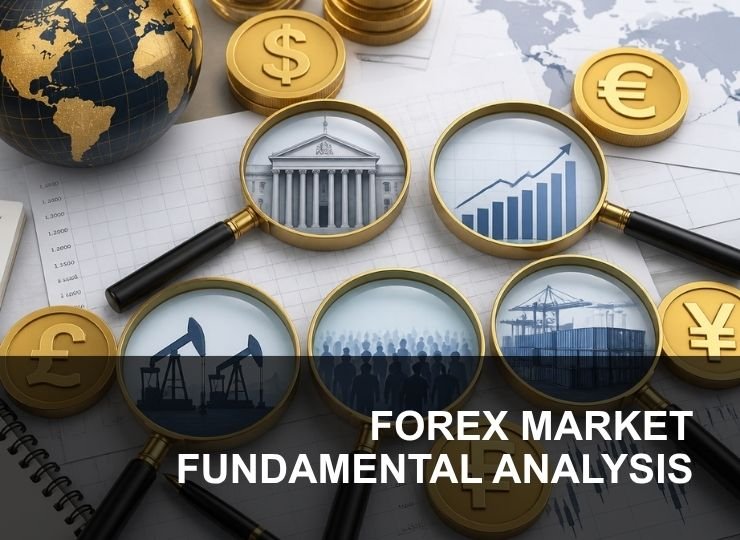
Forex market fundamental analysis examines the economic, political, and financial factors that influence currency movements, including interest rates, inflation, employment data, central bank policies, and global events to determine the strength or weakness of a currency
You check the chart. Price is ripping in one direction with no warning. No obvious technical trigger. No pattern you were watching.
Then you check the news: a central bank just changed interest rates, or a jobs report came in hotter than expected.
That's forex market fundamental analysis at work, and if you don't understand it, you're trading half-blind.
This guide breaks down how economic indicators, central bank policies, and global events actually move currency pairs and how to start reading them like a professional trader instead of reacting to them like a spectator.
What Is Forex Market Fundamental Analysis?
Fundamental analysis is the study of the real-world economic, political, and financial forces that drive a currency's value.
Where technical analysis looks at price charts, fundamental analysis looks at why the price is moving in the first place.
Think of a currency as a stock in a country. If that company (the economy) is doing well, with strong growth, low unemployment, and controlled inflation, investors want to own its currency. If the outlook weakens, they sell.
Every currency pair you trade, EUR/USD, GBP/JPY, USD/JPY, is really a comparison between two economies. Fundamental analysis is how you read that comparison.
Why Fundamentals Matter Especially If You're Trading From the UAE
Dubai and the wider UAE sit at a unique crossroads for forex traders.
The dirham is pegged to the US dollar, which means US economic data doesn't just affect USD pairs; it ripples directly into the cost of living, imports, and investment decisions across the region.
At the same time, UAE-based traders are often active during the London and New York sessions, which is exactly when the biggest economic releases and central bank announcements hit the market.
That overlap creates opportunity but only for traders who understand what they're reacting to. Without that knowledge, high-impact news events feel random and dangerous instead of predictable and tradeable.
The Three Pillars of Fundamental Analysis
Fundamental analysis isn't one thing; it's built on three interconnected forces. Understanding each one separately makes it far easier to read the bigger picture.
1. Economic Indicators
Economic indicators are scheduled data releases that reveal the health of a country's economy. They're the pulse checks the market waits for every week.
The ones that consistently move currency pairs include:
- GDP (Gross Domestic Product): Measures overall economic output. Strong GDP growth typically strengthens a currency.
- Inflation data (CPI): Shows whether prices are rising too fast, which often signals upcoming interest rate decisions.
- Non-Farm Payrolls (NFP): The US monthly jobs report, one of the most volatile release dates on the forex calendar.
- Retail Sales: Provides a snapshot of consumer spending strength.
- Unemployment Rate: High unemployment usually weakens a currency, while low unemployment often strengthens it.
A simple rule of thumb: strong data generally supports a stronger currency, and weak data generally pressures it lower. But context matters; a beat against expectations moves markets more than the raw number itself.
2. Central Bank Policies
If economic indicators are the pulse, central bank policies are the doctor deciding what to do about it.
Central banks like the US Federal Reserve, the European Central Bank, and the Bank of England control interest rates and interest rates are arguably the single biggest driver of currency value.
Here's the logic in plain terms: higher interest rates attract foreign investment because investors earn more holding that currency. More demand for the currency means it strengthens.
When a central bank hints at raising rates, the currency often rallies before the actual decision because markets trade on expectations, not just outcomes.
This is why traders watch central bank meeting minutes, press conferences, and even single words in official statements; subtle language shifts can move markets within seconds.
3. Political and Global Events
Political and global events are the wildcard variable, the ones that don't follow a calendar.
Elections, trade negotiations, wars, sanctions, oil supply shocks, and geopolitical tension can all send currencies swinging, sometimes more violently than any scheduled data release.
For UAE-based traders, oil-linked currencies like the Canadian dollar or Russian ruble are particularly sensitive to Middle East developments and OPEC+ decisions, events that are quite literally happening in the region you're trading from.
The takeaway: fundamental analysis isn't only about spreadsheets and data calendars. It's about staying globally aware.
How to Actually Trade With Fundamental Analysis: A Step-by-Step Approach
- Start with an economic calendar. Know what's being released each day and its expected impact level (low, medium, high).
- Check the forecast vs. previous data. The market reacts to surprises, not just the number itself.
- Understand the currency pair's exposure. If trading EUR/USD, both Eurozone and US data matter, not just one side.
- Watch central bank commentary, not just rate decisions. Forward guidance often moves the price more than the actual rate change.
- Combine fundamentals with technical levels. Use fundamentals to understand direction and bias; use technical analysis to time your entry.
- Manage risk around high-impact events. Volatility spikes around news releases, wider spreads and slippage are common, so position sizing matters more than ever.